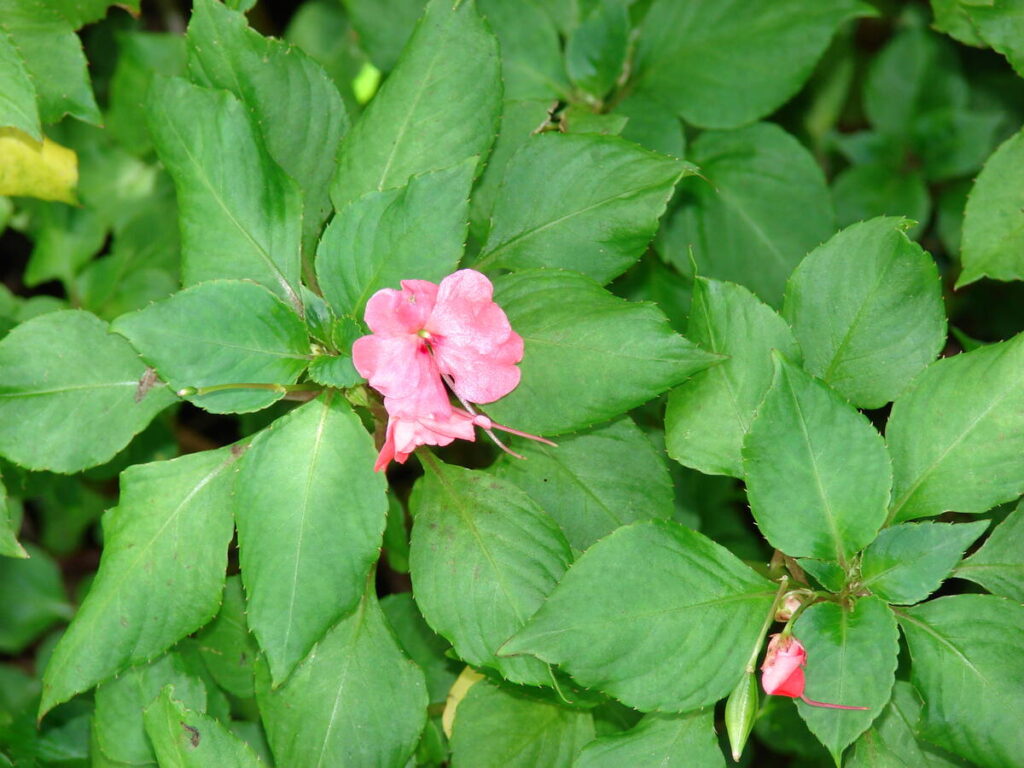
Busy Lizzie brings colour to shaded spaces, but its easy spread deserves as much attention as its flowers. Impatiens walleriana is known in Brazil as maria-sem-vergonha, beijo or beijinho. Before treating it as an uncomplicated garden choice, check whether it is suitable and permitted where you live.
Jurisdiction note: the legal restriction discussed here belongs specifically to Santa Catarina, a Brazilian state. It is not a nationwide Brazilian ban and must not be applied as the law of another state or country. Consult the environmental authority where the plant is located.
Recognising the plant
This African plant forms a low, leafy clump, commonly around 20–60 cm tall. Oval leaves have toothed edges, and the broad flowers come in several colours. Cultivars differ in size and flower form. The common name alone does not distinguish it from other Impatiens, including New Guinea impatiens and sun-tolerant hybrid groups.
It does produce fruit: small dry capsules containing seeds, not fleshy fruit for the table. When mature, the capsules open abruptly and disperse the seeds. Finding seedlings beyond a bed is therefore a reason to reconsider containment, not simply celebrate effortless propagation.
An important restriction in Santa Catarina
Santa Catarina’s CONSEMA Resolution 271 of 30 May 2025 lists Impatiens walleriana in Category 1. Article 3 prohibits activities including possession, trade, transport, propagation and cultivation; Article 4 provides for specific scientific-use authorization. This state rule is not a nationwide ban. Consult IMA about existing plants and appropriate handling rather than starting or expanding a planting in Santa Catarina. This restriction applies to Santa Catarina, Brazil, not automatically to other Brazilian states or foreign countries. Check the rules with the environmental authority where you live.
Elsewhere, check local requirements and ecological suitability. Do not introduce plants or discard viable material into woodland, beside springs or along streams. For a new shaded garden, a locally appropriate native alternative may be the more responsible choice. This guide is not a recommendation to plant the species without those checks.
Light and water where cultivation is allowed
Part shade to shade suits ordinary busy Lizzie. Do not transfer full-sun claims made for particular hybrids to every plant with the same common name. A moisture-retentive but freely draining growing medium helps avoid the two extremes: drying out completely and remaining waterlogged.
Check the soil before watering a wilted plant. Hot, dry conditions may cause wilting, but adding water to an already saturated pot can worsen root problems. Use drainage holes and let excess water escape. A promise that every collapsed plant will recover within hours is not realistic.
Frost and low temperatures limit outdoor survival. Flowering duration depends on climate and cultivar rather than a universal year-round schedule. Fertilizer decisions should reflect the growing medium and product label, not an automatic monthly dose for every pot or bed.
Watch for downy mildew
Yellowing, rapid leaf loss and whitish growth beneath leaves can indicate downy mildew. This disease can severely damage I. walleriana; it is not simply a watering problem. Seek a reliable diagnosis, separate affected material from healthy plants and do not distribute cuttings from suspect plants. RHS advises against home composting diseased material. Follow local disposal guidance rather than dumping it outdoors.
Disease-resistant cultivars exist, but resistance does not mean immunity or exemption from environmental restrictions. Do not choose a fungicide solely because a plant looks unwell; diagnosis and locally authorised uses matter.
Pets and consumption
ASPCA lists Impatiens species as non-toxic to dogs and cats. That classification is not a recommendation for people or animals to eat garden plants, and does not establish that any unidentified plant sold under a similar name is safe. This is an ornamental guide, not advice on edible or medicinal use.
A similar need to distinguish garden appeal from environmental suitability appears in the blue trumpet vine guide. That climber is not an alternative recommendation for this shaded planting; the link offers another example of why species-specific checks matter.
References
NC State Extension: Impatiens walleriana; NParks: botanical description; RHS: Impatiens growing guide; RHS: downy mildew; ASPCA: Impatiens; Santa Catarina: CONSEMA 271/2025, Articles 3–4 and annex, page 7.
Cover: Impatiens walleriana, Forest & Kim Starr / Wikimedia Commons, CC BY 3.0; resized and compressed. Cultivar not identified.
Source context: NC State and ASPCA are United States sources, RHS guidance comes from the United Kingdom, and NParks from Singapore. Their botanical, horticultural and animal-health information does not establish legal rules for the reader’s country.