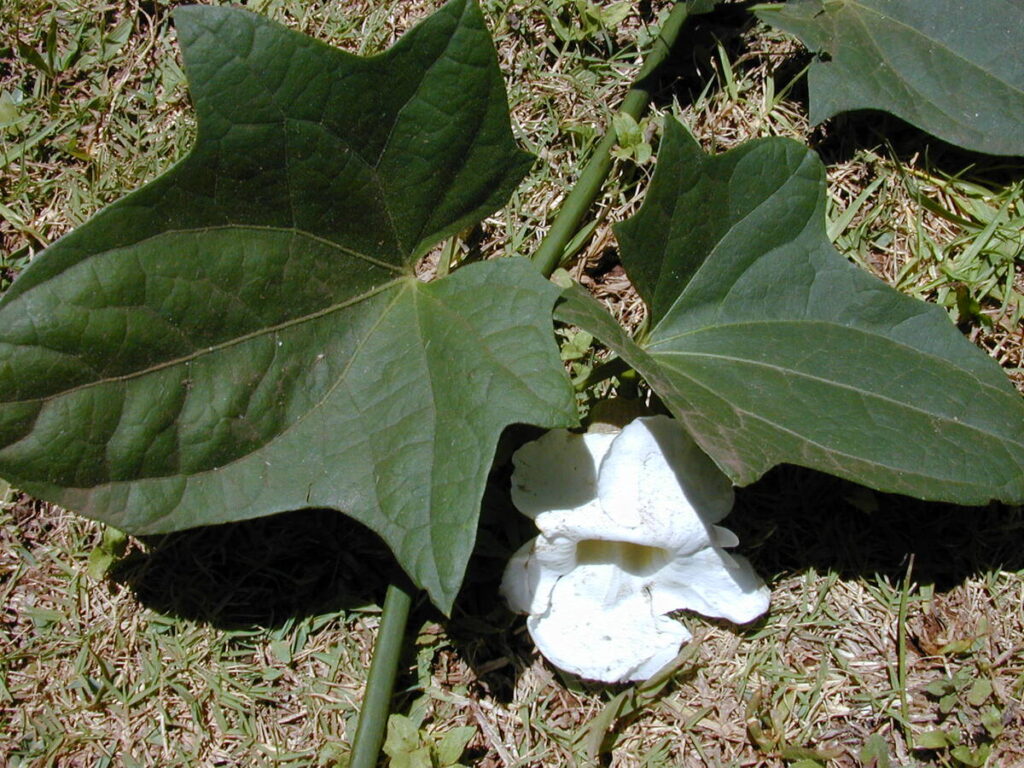
Blue trumpet vine, also called Bengal clock vine or skyflower, is known for its flowers and exceptionally vigorous growth. With Thunbergia grandiflora, that vigour is also the main reason to pause before planting. An attractive climber can become an environmental problem when it spreads beyond the garden.
Jurisdiction note: the legal restriction discussed here belongs specifically to Santa Catarina, a Brazilian state. It is not a nationwide Brazilian ban and must not be applied as the law of another state or country. Consult the environmental authority where the plant is located.
This is a guide to recognising the plant and understanding its risks, not a recommendation to propagate or introduce it. Check the situation where you live before choosing it for a wall, fence or pergola.
Recognising blue trumpet vine
Singapore’s NParks places this climber in Acanthaceae and lists several of its English common names. The RHS describes woody, twining stems, broad heart-shaped leaves and trumpet-shaped, pale violet-blue flowers with a yellowish throat. Its stems wind around supports; describing them as tendrils is misleading.
The plant can climb several metres. Its eventual size depends on the conditions and available support, so a small nursery plant does not indicate the space an established vine may occupy. Common names alone are not enough to distinguish different members of the genus.
Why escape from gardens matters
The Queensland government’s fact sheet documents vines smothering native vegetation and regeneration from stem and tuberous-root fragments. Root pieces can move with floodwater or transported soil. These observations help explain the ecological risk; Australian legal provisions are not Brazilian rules.
For a garden owner, the practical implication is that cutting back visible shoots is not the same as preventing spread. The material removed and the soil moved during work also need attention. A fence is not an ecological boundary that the plant necessarily respects.
The specific restriction in Santa Catarina
Brazil’s state of Santa Catarina lists T. grandiflora in category 1 under CONSEMA Resolution 271 of 30 May 2025 (annex, page 10). Article 3 prohibits activities including cultivation, propagation, sale and donation; specific authorised exceptions are addressed in the resolution. This is a state rule, not a nationwide Brazilian ban. This restriction applies to Santa Catarina, Brazil, not automatically to other Brazilian states or foreign countries. Check the rules with the environmental authority where you live.
Elsewhere, consult the competent environmental authority. Not knowing of a restriction is not evidence that introducing the vine is environmentally appropriate. For that reason, this article does not provide a propagation tutorial.
Understanding growing conditions without encouraging spread
The RHS describes bright conditions and moist but well-drained soil, and records pests such as aphids, mealybugs, whiteflies and mites under protected cultivation. Those British growing observations should be interpreted in context, not converted into a universal watering calendar or a claim that the plant is immune to pests.
Container size, drainage, rainfall and heat change how quickly a growing medium dries. These general considerations describe plant care; they do not override restrictions on keeping or cultivating the species.
If the vine is already present
Do not give away cuttings or dump pruning debris and roots beside streams, woodland or vacant land. Ask the local environmental authority how existing plants and waste should be managed. Avoid improvised removal that scatters fragments, and do not transfer herbicide instructions from another country’s fact sheet to a Brazilian garden.
When choosing a replacement climber, match it to the local environment and available space, with preference for suitable native alternatives. The aim is not merely to cover a structure quickly, but to do so without creating a problem beyond the garden.
The comparison of pothos and dragon-tail plant explains another reason to check scientific names before choosing a climber. Its species and restrictions must be evaluated separately, rather than transferred from this vine.
Cover photograph: Forest & Kim Starr / Wikimedia Commons, CC BY 3.0. Photographed in Makawao, Maui; resized and compressed. The photograph illustrates the species, not a recommendation to plant it.
Source context: NParks describes plants in Singapore; RHS guidance comes from the United Kingdom; the ecological fact sheet comes from Queensland, Australia. These sources support botanical or ecological points, not the transfer of those places’ legal rules to the reader’s location.