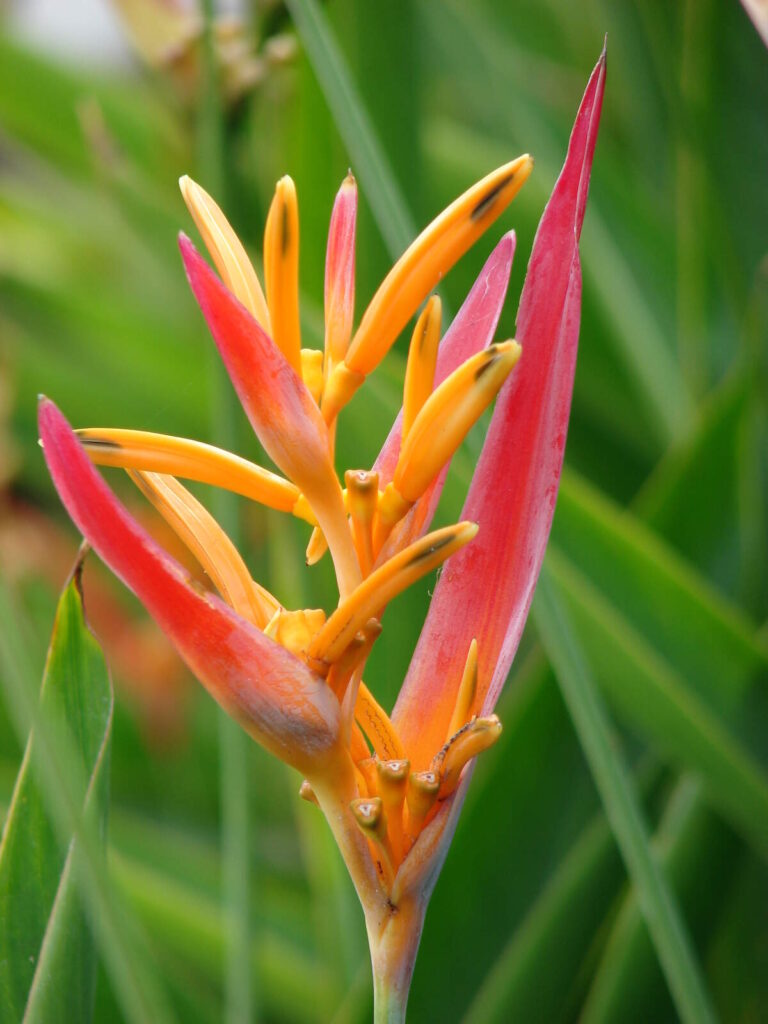
Parrot heliconia brings a tropical garden to life with narrow, colourful bracts held above fresh green leaves. Heliconia psittacorum is especially useful when you want a planted group rather than a single dramatic specimen. The practical question is not simply whether it likes heat: it is how much light and room your particular plant will receive.
Know which heliconia you are buying
Kew accepts Heliconia psittacorum as a species native from Panama into tropical South America, including Brazil. The colourful structures are bracts; the flowers emerge among them. Brazilian names include helicônia-papagaio and caetezinho, while parrot heliconia is a useful English name.
Ask for the cultivar name as well. Embrapa describes ‘Sassy’ separately from ‘Golden Torch’, which is a hybrid involving H. psittacorum and H. spathocircinata. Their dimensions and flowering behaviour should not be treated as interchangeable. A photograph of a yellow-flowered hybrid does not tell you exactly what another plant will become.
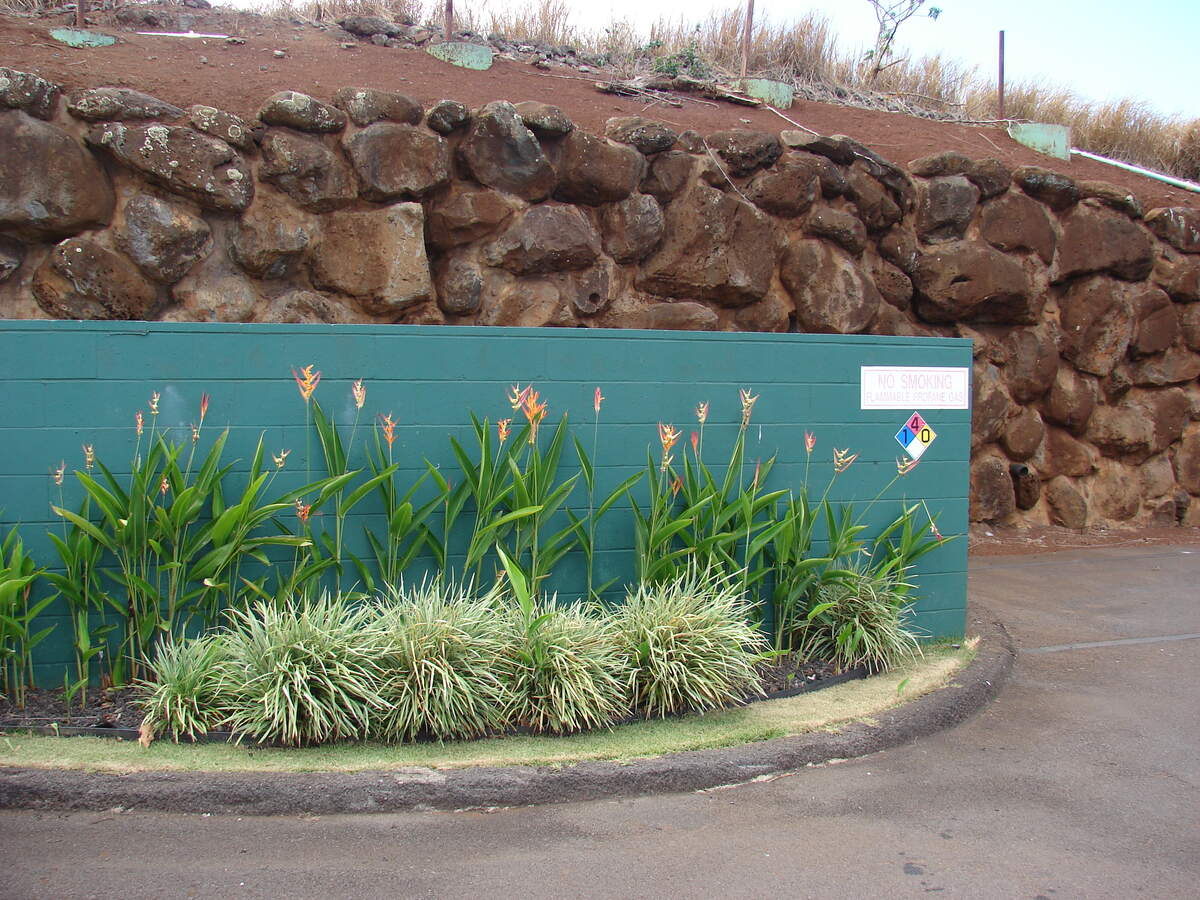
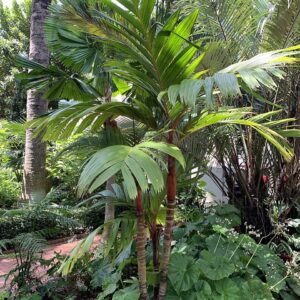
The heliconias are the taller plants at the back of this bed. Photo: Forest & Kim Starr, CC BY 3.0; resized and compressed.
Sun or shade?
The USP botanical garden recommends full sun or partial shade, with organic matter and consistent soil moisture. This is not a plant that must always be hidden from direct light. Consider the local climate, the exposure it had at the nursery and the conditions in the bed before choosing its position. Protect a recently divided plant while it establishes rather than abruptly exposing it to a hotter site.
Flowering and growth are not governed by a universal timetable. A study published in 2025 followed native material from Chapadinha, Maranhão, and found a smaller, slower-growing plant under the local experimental conditions. Do not transfer its measurements to every nursery cultivar, or assume that a vigorous garden clump will stay the same size.
Soil, water and feeding
NParks lists moist, well-drained soil and division for the cultivar ‘Lady Di’. The useful distinction is between moisture and stagnant water: check drainage before increasing watering. Rainfall, container size and heat change how quickly the soil dries, so a fixed daily schedule can be misleading.
Assess the bed before adding fertiliser. Follow the product label and avoid automatically applying more whenever flowering slows. If the soil stays wet and the plant declines, additional water and fertiliser are not a diagnosis. Check roots, drainage and possible damage first.
Leave space for the clump
A UFRPE study with Embrapa participation compared 26 heliconia genotypes and found substantial differences in shoot production and occupied area. Its practical lesson is that one spacing rule does not suit every heliconia. Keep access around the group and allow for expansion without blocking a path or crowding slower neighbours.
UF/IFAS recommends division into substantial rhizome sections for propagation. Use healthy cultivated material, and keep plant labels with the divisions. Containers need room for the underground stems as well as drainage. Heliconias are tropical plants: in a cold region, plan protection before planting, rather than treating a summer display as proof of winter hardiness.
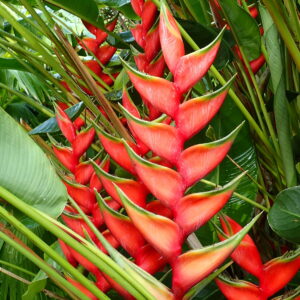
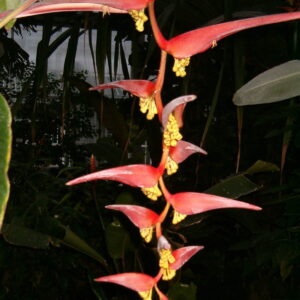
For a contrasting silhouette, compare this upright plant with the hanging inflorescences of Heliconia collinsiana. A group where both forms remain visible is more effective than squeezing them into the same crowded corner.
Usamos cookies em nosso site para fornecer a melhor experiência de uso, lembrando suas preferências e visitas repetidas. Ao clicar em “Aceitar”, concorda com a utilização de TODOS os cookies.
Este site usa cookies para melhorar sua experiência enquanto você navega pelo site. Destes cookies, os cookies que são categorizados como necessários são armazenados no seu navegador, pois são essenciais para o

funcionamento das funcionalidades básicas do site. Também usamos cookies de terceiros que nos ajudam a analisar e entender como você usa este site. Esses cookies serão armazenados em seu navegador apenas com

o seu consentimento. Você também tem a opção de bloquear esses cookies. Porém, a desativação de alguns desses cookies pode afetar sua experiência de navegação.
Os cookies necessários são absolutamente essenciais para o funcionamento adequado do site. Esta categoria inclui apenas cookies que garantem funcionalidades básicas e recursos de segurança do site. Esses cookies não armazenam nenhuma informação pessoal.
Quaisquer cookies que possam não ser particularmente necessários para o funcionamento do site e sejam usados especificamente para coletar dados pessoais do usuário por meio de análises, anúncios e outros conteúdos incorporados são denominados cookies não necessários. É obrigatório obter o consentimento do usuário antes de executar esses cookies no seu site.