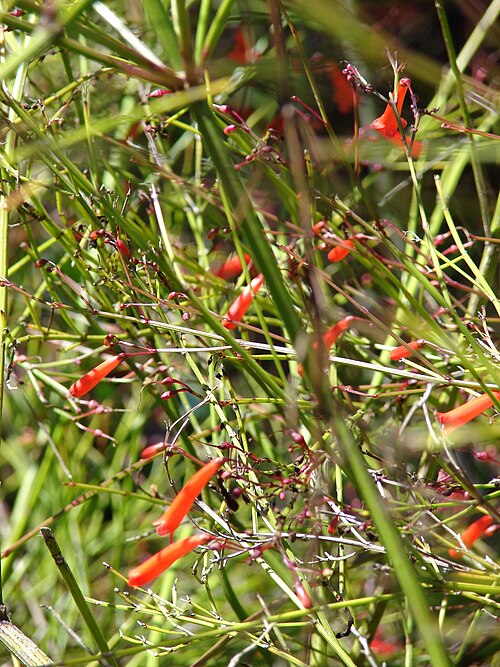
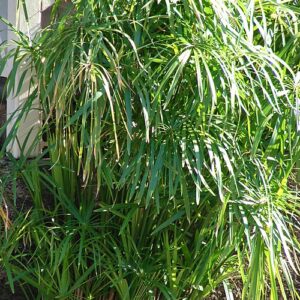
Firecracker plant is at its best when it has room to fall in loose arches. Its thin green stems and red tubular flowers soften a wall, brighten a sunny container and bring movement to a border. Known in Brazil as flor-de-coral, Russelia equisetiformis is better treated as a spreading shrub than squeezed into a small, tightly clipped shape.
Know the plant before choosing its place
Kew accepts Russelia equisetiformis in the Plantaginaceae family and identifies Mexico as its native range. The older name Russelia juncea is a synonym. It is a perennial, so it can remain part of a garden for years when the climate and growing conditions suit it.
NParks describes a multi-branched plant roughly 1–1.5 m tall, potentially much wider. Young stems stand upright before bending; the small leaves are reduced and the red flowers form narrow tubes around 2.5 cm long. Its fine texture is part of the appeal. The apparent empty space around the branches should be included in the planting plan, not filled immediately with competing plants.
Sun, warmth and realistic expectations
A sunny position encourages flowering. UF/IFAS notes that the flowers attract hummingbirds and butterflies and that yellow and salmon-coloured forms are also available. A plant can flower over a long period in a suitable warm climate, but a year-round display should not be promised in every garden. Well-drained soil is more important than an elaborate soil recipe.
Cold tolerance needs context. The University of North Florida reports that plants in Jacksonville can die back to ground level in a very cold winter and resprout in spring. That observation does not guarantee survival in a colder region. Where frost is likely, a movable container and protected winter position are a more cautious choice than assuming the plant is either frost-proof or always killed by any cold spell.
Watering and feeding without fixed dates
Established plants tolerate drought, but that does not mean a newly planted shrub or a small pot can be ignored. UF/IFAS reports better flowering with regular irrigation. Check the root zone before watering and adjust to rain, heat and container size. “Three times a week” is not a dependable rule for every balcony or soil.
For container growing under protection, the RHS recommends moderate watering during growth, less in winter and a balanced liquid feed during active growth. Follow the product label rather than combining several fertilisers. A container needs a draining growing medium and an outlet for excess water; do not turn a decorative outer pot into a reservoir around the roots.
A cascading shape is its main landscaping strength
The University of Florida’s Charlotte County Extension highlights walls and large hanging baskets as good ways to show the arching stems. The plant needs lateral room, not just planting depth. Its reported moderate salt tolerance may be useful in some coastal gardens, but it should not be read as a guarantee against constant salt spray.
Before installing a basket, consider how much it weighs after watering and whether its fixing is suitable. Near a path, allow the mature stems to hang without brushing people or hiding the edge of a step. If the only available space requires constant cutting back, choose a smaller plant instead. A single well-positioned specimen often works better than several crowded ones.
Propagation and routine care
The RHS lists softwood cuttings and separating rooted layers as propagation methods. NParks also lists stem cuttings. A layer is a stem that has formed its own roots while still attached to the parent. Separate it only after those roots have developed, then let the young plant establish before treating it like a mature drought-tolerant shrub.
Remove dead or damaged stems with clean tools and retain the natural arching outline rather than forcing every branch into a flat hedge. Check the plant’s growing conditions if flowering declines: more fertiliser is not automatically the answer. This is an ornamental guide, not a recommendation to eat the plant or use it as a remedy.
Usamos cookies em nosso site para fornecer a melhor experiência de uso, lembrando suas preferências e visitas repetidas. Ao clicar em “Aceitar”, concorda com a utilização de TODOS os cookies.
Este site usa cookies para melhorar sua experiência enquanto você navega pelo site. Destes cookies, os cookies que são categorizados como necessários são armazenados no seu navegador, pois são essenciais para o

funcionamento das funcionalidades básicas do site. Também usamos cookies de terceiros que nos ajudam a analisar e entender como você usa este site. Esses cookies serão armazenados em seu navegador apenas com

o seu consentimento. Você também tem a opção de bloquear esses cookies. Porém, a desativação de alguns desses cookies pode afetar sua experiência de navegação.
Os cookies necessários são absolutamente essenciais para o funcionamento adequado do site. Esta categoria inclui apenas cookies que garantem funcionalidades básicas e recursos de segurança do site. Esses cookies não armazenam nenhuma informação pessoal.
Quaisquer cookies que possam não ser particularmente necessários para o funcionamento do site e sejam usados especificamente para coletar dados pessoais do usuário por meio de análises, anúncios e outros conteúdos incorporados são denominados cookies não necessários. É obrigatório obter o consentimento do usuário antes de executar esses cookies no seu site.