A white fringe around a yellow centre is the familiar picture of a daisy. But “daisy” is a common name, not the identity of a single plant. Several different species share that flower shape, and their care is not interchangeable. Before choosing one for a pot or border, check the botanical name on its label.
What makes a daisy look like a daisy?
In the Asteraceae family, the apparent flower is actually a flower head made up of many small flowers called florets. The outer ray florets give many daisies their petal-like fringe. This shared structure does not mean that every daisy has the same leaves, lifespan or growing needs.
Four plants worth telling apart
Oxeye daisy (Leucanthemum vulgare). A perennial with white rays and a yellow centre. Its basal leaves are spoon-shaped, and established plants spread through rhizomes. It suits sun or partial shade and moderately fertile, moist but well-drained soil. Removing spent heads tidies the display; division is one way to propagate it. A perennial can survive for several years, unlike an annual that completes its life cycle in one growing season.
Crown daisy (Glebionis coronaria). Older labels may say Chrysanthemum coronarium. Kew accepts it in the genus Glebionis, with a native range from the Mediterranean towards Central Asia and the Arabian Peninsula. This annual has deeply divided foliage. Give it a sunny position and moisture without waterlogging. It should not be confused with the many cultivated florist’s chrysanthemums.
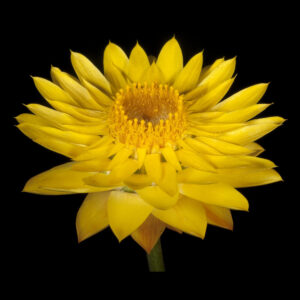
Corn marigold (Glebionis segetum). Also previously called Chrysanthemum segetum, this annual carries yellow flower heads and slightly fleshy, lobed leaves. The RHS recommends sun and well-drained sandy soil and notes its intolerance of lime. Rich compost and extra lime are therefore not a universal recipe for every plant sold as a daisy.
Glebionis segetum. Photo: Sara Gold, Wild Flowers of Israel (צילום: שרה גולד, צמח השדה), Wikimedia Commons, CC BY 2.5. Resized.
Indian chrysanthemum (Chrysanthemum indicum). This is a perennial, rather than another name for the two annual species above. The RHS describes yellow, single flower heads, divided aromatic foliage and a height around 60 cm. Grow it in sun with fertile, moisture-retentive but well-drained soil. Its skin-allergen warning is a reason to wear gloves when handling it, not to treat all daisies as harmless.
Growing them in pots without a rigid watering calendar
Start with a container that has drainage holes. Illinois Extension explains that a gravel layer underneath potting mix does not improve drainage: water can remain in the finer material above it. Empty water collected in a saucer or decorative outer pot. Choose the growing medium for the identified species, rather than adding the same fertiliser mixture to every pot.
Check the growing medium and the plant’s condition before watering. Pot size, weather and growth all change how quickly moisture is used. A fixed weekly schedule cannot account for a hot exposed balcony and a sheltered cool garden. Likewise, do not apply a July or August pruning rule everywhere: seasons differ between hemispheres, and annuals and perennials need different treatment.
A pretty border still needs the right plant
For a relaxed look, repeat a small group along a border instead of mixing many unrelated varieties in a tight space. On a balcony, choose the plant first and a suitably sized container second. A flower arrangement is decorative, but a living pot also needs the light its species requires.
Check local invasive-plant guidance before planting outdoors. Missouri’s conservation department describes oxeye daisy escaping gardens and becoming problematic in parts of the United States. That is a regional warning, not evidence of a universal ban or of a Brazilian prohibition. Nor does a familiar common name establish that a plant is suitable for food or home remedies.
Usamos cookies em nosso site para fornecer a melhor experiência de uso, lembrando suas preferências e visitas repetidas. Ao clicar em “Aceitar”, concorda com a utilização de TODOS os cookies.
Este site usa cookies para melhorar sua experiência enquanto você navega pelo site. Destes cookies, os cookies que são categorizados como necessários são armazenados no seu navegador, pois são essenciais para o

funcionamento das funcionalidades básicas do site. Também usamos cookies de terceiros que nos ajudam a analisar e entender como você usa este site. Esses cookies serão armazenados em seu navegador apenas com

o seu consentimento. Você também tem a opção de bloquear esses cookies. Porém, a desativação de alguns desses cookies pode afetar sua experiência de navegação.
Os cookies necessários são absolutamente essenciais para o funcionamento adequado do site. Esta categoria inclui apenas cookies que garantem funcionalidades básicas e recursos de segurança do site. Esses cookies não armazenam nenhuma informação pessoal.
Quaisquer cookies que possam não ser particularmente necessários para o funcionamento do site e sejam usados especificamente para coletar dados pessoais do usuário por meio de análises, anúncios e outros conteúdos incorporados são denominados cookies não necessários. É obrigatório obter o consentimento do usuário antes de executar esses cookies no seu site.