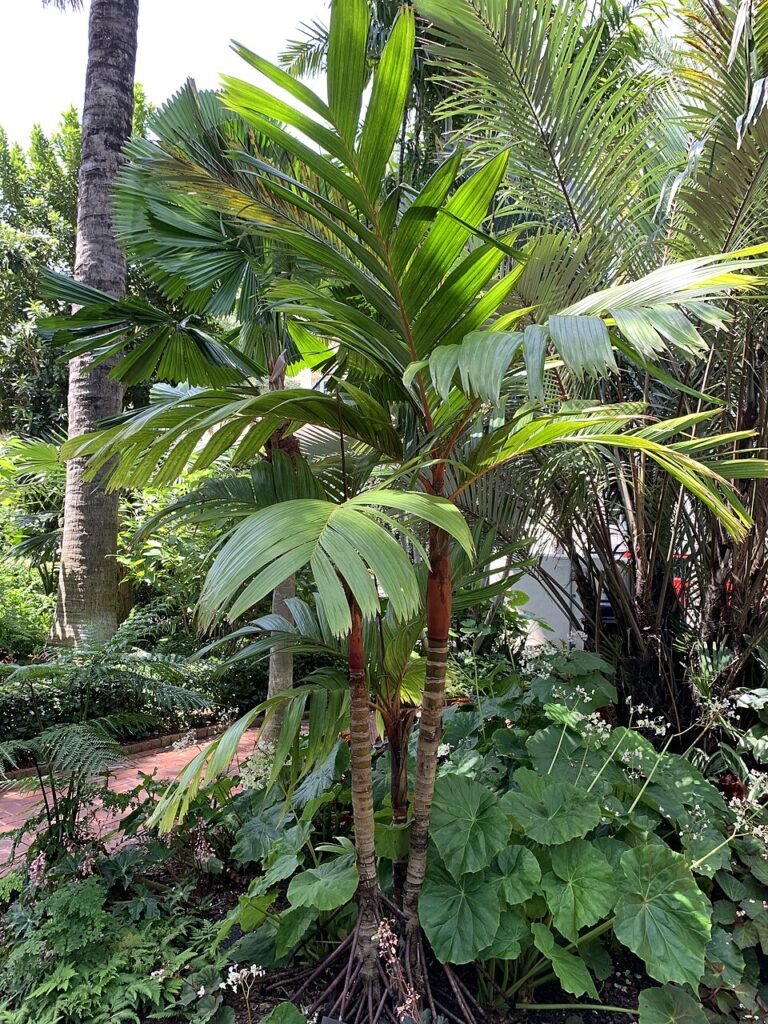
The orange crownshaft palm (Areca vestiaria) brings colour to a tropical garden before it produces a single flower. Its orange to reddish leaf bases form a smooth collar beneath the green crown. That contrast is the feature to plan around, but the plant also needs a sheltered, humid environment: it is not a palm to choose solely for its photograph.
Confirm the species before buying
Common names such as “areca” can refer to different palms. This guide concerns Areca vestiaria, a name accepted by Kew’s Plants of the World Online. Its native range extends from Sulawesi to Maluku in Indonesia, within the wet tropical biome. Check the scientific name on the nursery label rather than transferring care instructions from another plant sold as an areca.
The plant belongs to Arecaceae. Its leaves are pinnate: separate leaflets sit along a central stalk. The coloured collar is the crownshaft, not a collection of orange leaves. Cream-coloured flowers and orange-red ripe fruits add interest, but the plant is presented here for ornamental use, not as a home food crop.
A single stem or a clump?
Both forms occur. The San Diego Botanic Garden describes solitary and clustered specimens, sometimes with conspicuous supporting roots near the base. Do not assume that every plant will develop the same outline or that every single-stemmed specimen can be divided.
The crownshaft can range from orange to deep reddish tones. Give it a position where the lower crown remains visible instead of hiding the colour behind dense planting. In a mixed tropical composition, green foliage can provide a quieter background.
Light, moisture and room to grow
The NParks species profile describes an understorey palm suited to shade or partial shade, with high humidity and regular moisture. Choose bright, filtered light rather than exposing a shaded nursery plant abruptly to harsh midday sun.
Keep the growing medium moist but draining freely; do not allow repeated complete drying. Check the pot itself rather than following a fixed weekly watering schedule. Heat, airflow, pot size and the medium all affect how quickly it dries. A decorative outer pot must not trap water around the roots.
Plan for a substantial plant. NParks records a maximum height of 9 m and crown width of 5 m. These are planning references, not a promise for every specimen. A young palm in a pot may look manageable while still being unsuitable for a confined room or narrow passage later.
Can it live indoors?
A warm, bright conservatory can offer a very different environment from a dim room with dry air. Before choosing it as an indoor feature, assess the actual light, humidity and available headroom. Attractive foliage does not make a plant tolerant of every interior.
Avoid treating a quoted minimum temperature as a guarantee of cold tolerance. Its tropical origin is a reason to choose a protected growing environment, not to test how much frost a specimen can survive. For a garden with cold winters, a more locally suitable palm may be the better choice.
Propagation without a fixed deadline
Seeds and basal shoots are recorded propagation routes. Only a shoot with its own suitable root system is a possible candidate for separation; cutting through an arbitrary portion of a solitary stem is not equivalent to division. If you are unsure how the plant is structured, keep it intact and ask an experienced grower.
A 2021 UNESP study tested temperature and light in seed germination. For A. vestiaria, it recommended 30°C or an alternating 20–30°C regime under the experimental conditions. Germination was uneven. These results are useful nursery evidence, not a guarantee that every home-sown seed will sprout within a particular number of weeks.
Maintenance and sensible expectations
Inspect the palm when watering: look at new growth, the undersides of leaves and the condition of the growing medium. A pale or damaged leaf is a symptom to investigate, not an automatic instruction to add fertiliser or pesticide. When feeding, use an appropriate product according to its label and the growing conditions.
Keep healthy green fronds. General UF/IFAS palm-pruning advice favours removing only fully dead foliage when necessary, without forcing attached leaves loose. Removing yellowing foliage prematurely can hide signs of a nutritional problem. Its appeal is a full crown with a colourful base, not a heavily stripped stem.
Cover photograph: Katherine Wagner-Reiss, Wikimedia Commons, CC BY-SA 4.0. Taken at the Society of the Four Arts Garden, Palm Beach, Florida. Reduced-size version; the image remains under the same licence.