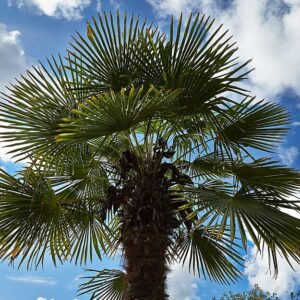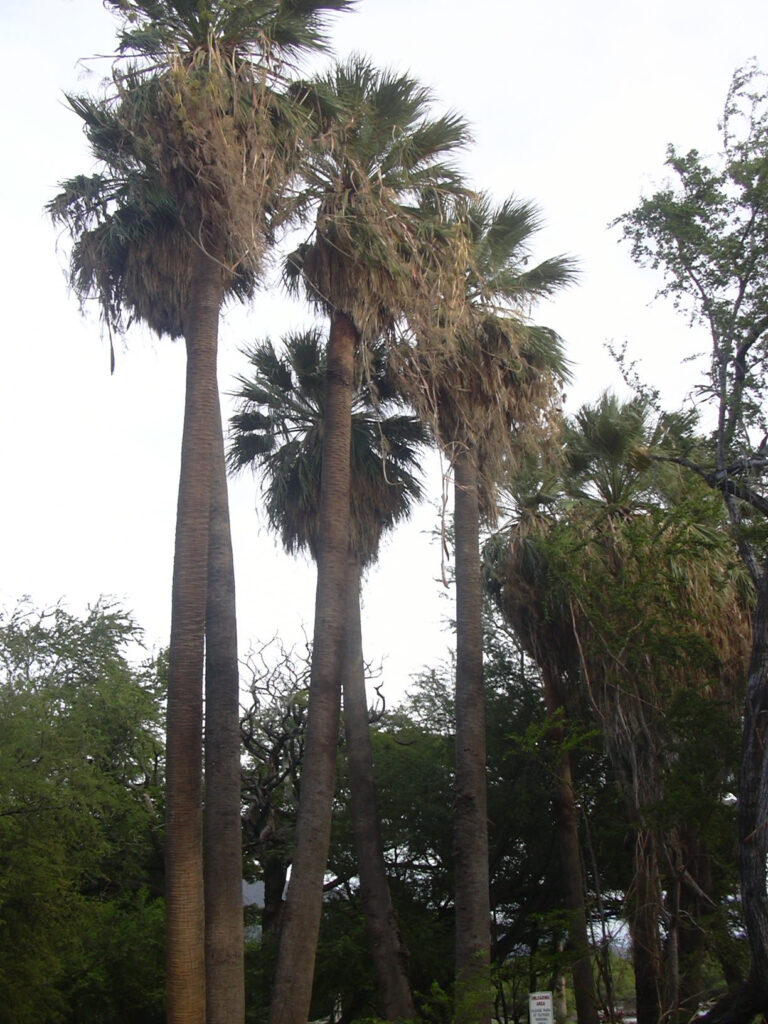
The California fan palm (Washingtonia filifera) is a large palm with a stout trunk and broad, fan-shaped leaves. Older leaves can remain hanging beneath the crown, forming the skirt that gives the plant one of its distinctive features. It belongs in a spacious outdoor landscape, not a narrow bed chosen only to fit a small nursery plant.
A desert palm, but not a plant without water
Its native landscapes include desert oases in the southwestern United States and northwestern Mexico. That combination matters: the surrounding climate may be dry, while roots have access to water. A desert origin should not be read as permission to let a newly planted palm dry out completely.
In cultivation, choose an open, sunny position and soil that drains well. Climate, drainage and available space matter more than a broad claim that the species grows in every warm region. Ask a local nursery about its performance in your area, especially where winters are severe or the climate is persistently humid.
How to recognize it
The leaves spread like fans and carry threadlike fibers along their segments. Their stalks have sharp teeth, so keep them away from areas where people brush past. Mature palms develop a substantial, upright trunk and can become much taller than a house.
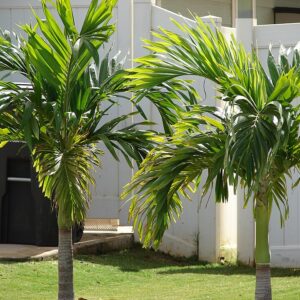
Do not confuse it with the Mexican fan palm, Washingtonia robusta, which generally develops a much more slender trunk. Nursery labels are useful, but a young palm is not always easy to identify from a photograph alone. Confirm the botanical name before buying, rather than choosing by the common name alone.
Think about the adult palm before planting
Allow room for the crown and for future maintenance. Avoid overhead wires and locations where fallen fronds could reach frequently used paths, parking spaces or play areas. A palm that fits neatly today may be difficult and expensive to manage once the crown is high above the ground.
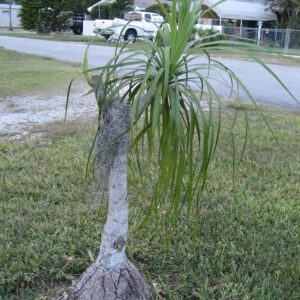
For smaller spaces, compare the scale and needs of the pygmy date palm. It is a different species with its own restrictions, including sharp spines, not a miniature version of Washingtonia.
Watering and soil: avoid a fixed calendar
During establishment, check moisture around the root ball and water according to soil conditions and weather. The aim is to moisten the root zone without leaving it waterlogged. Established palms can tolerate drier conditions, but irrigation advice from an arid region cannot simply be copied into a rainy garden.
If water remains standing after rain, address drainage before planting. Adding a small amount of sand to an unsuitable planting hole is not a universal solution. Similarly, yellow leaves do not automatically mean that the plant needs more water or fertilizer: root problems, nutrition and other stresses can look similar.
What to do with the dry skirt
The hanging leaves are part of the palm’s natural appearance and can provide shelter for wildlife. In a built landscape, however, accumulated dry material also needs to be considered in a fire and maintenance assessment. There is no single rule that suits a remote grove and a palm beside a house.
Have a qualified palm-care professional assess removal when it is necessary. Do not burn the skirt, climb beneath loose fronds or try to reach a tall crown with an improvised ladder. Avoid excessive pruning of healthy green leaves, and never cut into the trunk or the growing point at the top. Pruning should not be used to force faster growth.
Health and propagation
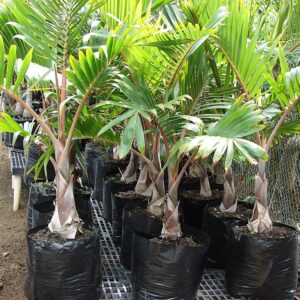
Seeds are used to propagate this palm, but germination varies with seed quality and conditions. For a landscape project, a correctly identified nursery-grown plant is often a more predictable starting point.
If leaves decline unexpectedly, seek a diagnosis before applying a pesticide. The University of California notes that “diamond scale,” a disease associated with this species in coastal California, is caused by a fungus, despite its insect-like name. A symptom seen in one region should not be assumed to have the same cause everywhere.
References and photograph
University of California, Irvine: Washingtonia filifera; University of Arizona Campus Arboretum: California fan palm; University of California IPM: palm diseases in the landscape.
Photograph: Forest & Kim Starr, Washingtonia filifera in Maui, via Wikimedia Commons, CC BY 3.0. Photograph used without alteration.