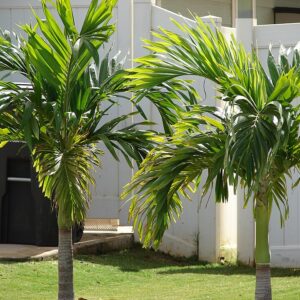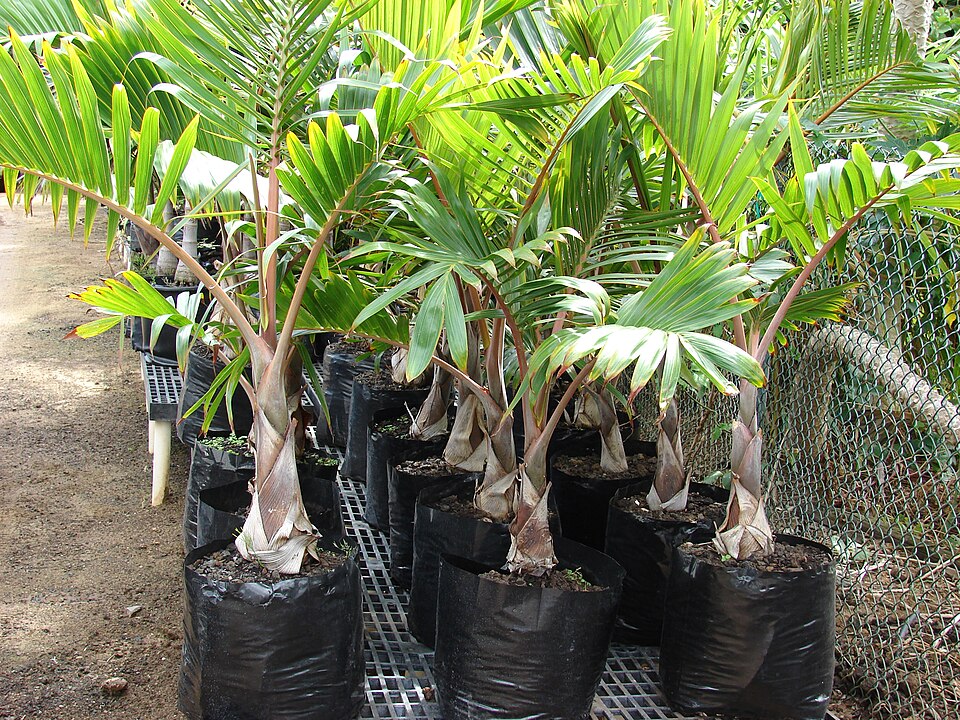
The bottle palm, Hyophorbe lagenicaulis, stands out even before you notice its leaves. Its swollen lower trunk narrows toward a smooth green crownshaft, creating the silhouette that gave the species its common name. In a warm garden, that shape can be a focal point without the plant needing a crowded planting scheme around it.
A tropical palm with a distinctive trunk
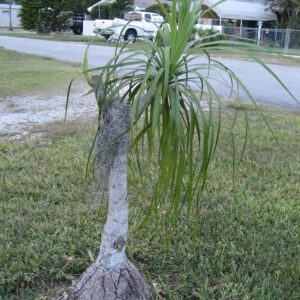
This is a true palm in the family Arecaceae, native to Mauritius in the Mascarene Islands of the Indian Ocean. It is not the ponytail palm, Beaucarnea recurvata, despite the similar common names sometimes used in plant shops. Check the scientific name when buying.
Growth is slow, but a mature bottle palm is not a permanently miniature plant. Expect a palm several metres tall with room needed for its spreading, feather-like fronds. The swollen base is especially noticeable in younger specimens; as the trunk lengthens, its proportions change.
A relatively open crown with only a few large leaves is part of its appearance, not necessarily evidence of a sick plant. Look at the condition of those leaves and the emergence of new growth rather than expecting the dense crown of a different palm.
Warmth comes first
The most important question is whether your climate suits it. Bottle palms need warmth and are highly sensitive to freezing conditions. In a cold-winter region, growing one outdoors permanently is a poor gamble, however attractive the plant looks in a nursery.
A container can make seasonal shelter possible, but only if you have enough light and space for the plant and can move it safely. A dim hallway is not a substitute for a suitable growing environment. Think about the size of the pot and mature foliage before buying.
Light, soil and watering
Choose a sunny position in a suitable warm climate; partial shade can also work. When moving a plant from sheltered nursery conditions, give it time to adjust rather than exposing it abruptly to a very different site.
The root zone should retain useful moisture while allowing excess water to drain. In a pot, use an appropriate well-drained growing mix and a container with drainage holes. Avoid leaving water trapped in a decorative outer pot.
Water according to the moisture in the root zone, the weather and the plant’s growth. Hot or dry periods may call for more attention, while cooler conditions slow drying. The broad trunk is not a reason to treat this palm like a desert cactus or leave it dry for long periods.
Feeding and maintenance
Use a palm fertiliser suited to your growing conditions and follow the product label. A fixed feeding interval cannot account for every soil, container or product. If foliage repeatedly yellows, check drainage and nutrition rather than adding more fertiliser blindly.
Keep pruning modest. Remove fully dead leaves carefully and do not cut healthy fronds merely to make the trunk more visible. Avoid injuring the central growing point. Inspect the underside of foliage for pests and identify a problem before choosing any treatment; use only products authorised locally for that ornamental use.
Growing from seed
Bottle palms are propagated from seed. Use seed from a reliable cultivated source and keep the sowing medium moist without saturating it. Germination can take months, so patience is more useful than repeated disturbance of the seed.
The plant has male and female flowers on the same individual. That is what “monoecious” means; it does not, by itself, guarantee self-fertilisation or that every flower will produce a viable seed. Small fruits darken as they mature.
Designing around its shape
Give a single specimen enough open space for its trunk to be seen, or use a carefully spaced group where the garden can accommodate mature crowns. Low planting can frame the palm, but choose companions with compatible watering needs rather than combining species solely for their appearance.
Being common in gardens does not mean a plant is secure in the wild. Kew’s species record cites a critically endangered IUCN assessment for the bottle palm. Buy nursery-propagated plants rather than specimens removed from natural populations; garden cultivation does not replace protection of habitat.
Sources and photograph
Royal Botanic Gardens, Kew: Hyophorbe lagenicaulis; UF/IFAS Extension: bottle palm; NParks: Hyophorbe lagenicaulis.
Cover photograph: Forest & Kim Starr, young Hyophorbe lagenicaulis in nursery containers, Wikimedia Commons, CC BY 3.0. Wikimedia’s resized preview; no crop or other edits.