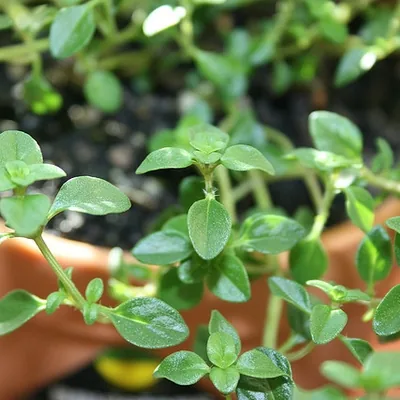
Thyme brings together tiny leaves, a strong aroma and a compact habit. This perennial herb suits sunny kitchen gardens, borders and pots, provided that excess water can drain away. The key is to give it light and avoid treating it like a vegetable that needs constantly moist soil.
Thyme at a glance
Scientific name: Thymus vulgaris L.
Family: Lamiaceae.
Life cycle: perennial, with a woody base.
Typical height: 15–30 cm (6–12 in).
Origin: southwestern Europe and southeastern Italy.
Light: full sun.
Planting thyme in a pot or garden bed
Choose a sunny position and plant at the same depth as in the nursery pot. The Royal Horticultural Society (RHS) suggests spacing plants 20–30 cm (8–12 in) apart, depending on the variety. Where soil stays wet for a long time, a pot or raised bed can make drainage easier to manage.
For one plant, the RHS gives a starting container size of at least 15 cm wide and 10 cm deep (about 6 by 4 in), with drainage holes. This is a minimum starting point, not a promise that the plant will never need more space. Gradually acclimatize plants raised under cover before moving them into their final outdoor position.
Watering: young plants and established thyme need different care
Newly planted thyme needs closer attention while its roots settle in. Once established, it needs less water. Check the growing mix before watering again rather than following a rigid calendar. Do not keep the root ball constantly wet: excess moisture encourages fungal problems and root rot. In pots, use a well-drained potting mix and keep drainage holes clear.
Thyme prefers well-drained soil with a neutral to alkaline pH. That does not mean you should add lime without testing the soil. First check the more immediate issue: is water draining away, or is the root ball still saturated between waterings? If foliage changes color, our guide to yellow leaves on plants explains how to look for the cause before choosing a treatment.
How to grow thyme from cuttings
Prepare a container, damp perlite and a clean, sharp cutting tool. Perlite is a lightweight material used for rooting cuttings. Iowa State University’s guidance on softwood cuttings, which includes thyme, uses young shoot tips about 5–10 cm (2–4 in) long. Remove leaves from the lower half, then insert that bare section into the rooting medium, keeping the remaining leaves above the surface.
Water lightly and keep the cuttings in indirect light. A clear plastic cover can help retain humidity, but inspect regularly and remove any moldy leaves or cuttings. Keep the perlite moist without letting the container stand in water. The guidance gives four to six weeks as a typical rooting period for many cuttings, not a guarantee for every plant.
A very gentle tug may reveal resistance from new roots. Once roots are about 2.5 cm (1 in) long, move the cuttings into individual pots. Give them good light as they grow. A stem that remains green is not necessarily a rooted plant.
Dividing, trimming and renewing the plant
You can also divide an established plant that has several shoots and a healthy root system. Lift the root ball, separate it into two or three sections and replant each one. Use a vigorous plant; splitting a small or weakened seedling is not the same as renewing a mature clump.
Trim lightly after flowering to keep thyme compact. Avoid cutting deeply into old, leafless wood, which may not produce new shoots. If the plant becomes very woody and open, growing replacements is usually a better approach than trying to restore its shape with drastic pruning.
Harvesting and drying thyme
Snip small leafy sprigs as needed. For drying, the University of Illinois recommends harvesting shortly before flowering. Tie small bundles and hang them in a warm, dark, well-ventilated place. Once dry, strip off the leaves and store them in a sealed container. Both fresh and dried leaves can be used in cooking.
Leave plenty of foliage at the first harvest so the plant can keep growing. Wait until cuttings have rooted or a transplanted plant has recovered before harvesting its new growth. For another kitchen-garden herb with different growing needs, see our guide to growing and harvesting basil.
Frequently asked questions
Does all thyme grow to the same size? No. Cultivars and other species in the genus can differ in size, scent and growth habit. This guide covers Thymus vulgaris; keep the plant label so you know what you are growing.
Why is my thyme woody with few leaves? Aging and a lack of light trimming can reduce leafy growth. Regular harvesting and gentle trimming help maintain the plant, while very old specimens may be better replaced with young plants.
Does this guide cover medicinal use? No. It covers cultivation and culinary use of the leaves. Essential oils and medicinal treatments require specific advice and should not be treated as equivalent to using thyme as a seasoning.
Sources
NC State Extension: thyme plant profile
RHS: growing thyme
University of California: thyme, division and renewal
Iowa State University: propagating herbaceous plants from stem cuttings
University of Illinois: thyme, harvesting and drying
Photo: Jason Baker, CC BY 2.0. Cropped square and compressed as WebP, without upscaling.