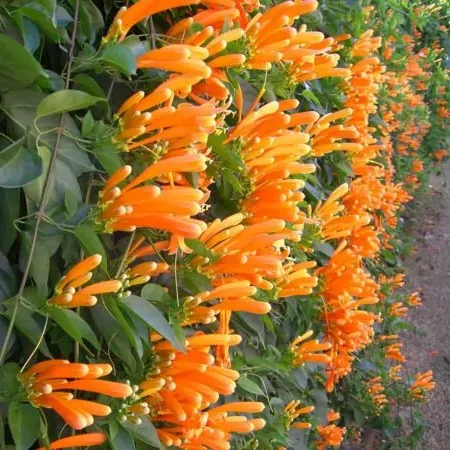
Flame vine turns fences and pergolas into flowering surfaces. Its orange tubular flowers appear in clusters, creating a display visible from a distance. That impact comes with vigorous growth: before planting, decide where the stems can spread and how you will maintain them. Pyrostegia venusta is better suited to a design with space and support for a climber than to a small area where its growth cannot be guided.
Plant profile
Common names: flame vine and orange trumpet vine; cipó-de-são-joão in Brazil.
Scientific name: Pyrostegia venusta.
Family: Bignoniaceae.
Habit: a perennial woody climber.
Origin: South America, including Brazil, Argentina, Bolivia and Paraguay, according to Singapore’s National Parks Board (NParks).
Growth: fast; attaches by tendrils, structures that curl around a support.
Foliage: compound leaves; part of the leaf structure may be modified into a branched tendril.
Flowers: orange, tubular and clustered.
Uses: fences, trellises, arbours and pergolas.
Propagation: cuttings and branch-rooting methods, including air layering, in which a stem forms roots before being detached from the parent.
Size: depends on the conditions and support; a single size does not describe its behaviour in every garden.
Where to plant and how to plan the support
Choose a sunny position with well-drained soil. NParks lists full sun to partial shade and moderate water needs. Vigorous growth requires both space and access for maintenance.
Do not allow it to use a tree you want to preserve as an unrestricted support: the vine can cover it. On fences, foliage and flowers tend to concentrate at the top. Shortening some stems helps spread coverage through the middle and lower sections.
Choose the permanent position before planting. Near a wall, leave room for roots and rainfall to reach the soil, avoiding the dry strip immediately against the masonry. The Royal Horticultural Society notes that very vigorous climbers are not ideal container plants. Where space allows, give flame vine its own bed and structure rather than relying on a small pot to contain its size.
How to plant flame vine
The following steps adapt the RHS’s general advice for planting climbers.
1. Install the support. Have the trellis, fence or pergola ready before the plant needs to climb. Choose a healthy plant with developed roots that are not excessively crowded in the container.
2. Prepare the spot. Dig a hole wider than the root ball and deep enough to keep its surface level with the surrounding soil. Remove the container and position the plant.
3. Backfill and water. Replace the excavated soil around the roots and firm it gently. Water to settle the soil into contact with the roots.
4. Guide the stems. Lead them onto the support with soft, loose ties that do not constrict the stem. Check new growth and redirect stems that wander away from the structure.
Watering after planting
Monitor moisture during establishment, especially in hot, dry or windy weather. Keep the soil moist without waterlogging. Needs change with rainfall, drainage and plant development; a fixed watering schedule cannot replace checking the soil.
The species’ recorded drought tolerance is not a reason to neglect a newly planted specimen. Established plants and young plants still adapting to their surroundings have different needs.
Flowering and the right time to prune
The Porto Alegre Botanical Garden visitor guide records flowering from autumn to late winter. This is a useful Brazilian reference, not a universal calendar. Observe when buds appear in your garden and record how long flowering lasts. Local observations are more useful for planning maintenance than choosing a fixed month.
According to NParks, cooler temperatures favour abundant flowering.
The RHS recommends pruning after flowering. Wait until your plant’s main display is over before reorganising the length of its stems. Rapid growth also calls for regular checks to keep the vine within its allocated space.
Growing but not flowering? Review sunlight and note when the last pruning took place relative to bud formation. Check whether your expectations come from local observations or a calendar for another region. This is a care checklist, not a diagnosis that justifies applying a flowering fertiliser without assessing conditions.
Propagating from cuttings
The RHS lists seed with warmth and semi-ripe cuttings for this species. Its general cutting technique can guide preparation, but cannot guarantee a rooting time for every garden.
1. Take the cutting. Choose a healthy stem that is firm at the base and soft at the tip. With clean secateurs, prepare a 10–15 cm cutting, making the cut just below a node, the point where a leaf emerges.
2. Insert it. Remove the lower leaves and soft tip. Insert the cutting into a suitable propagation medium.
3. Monitor it. Keep it moist, ventilated and protected from excessive heat. Remove rotting cuttings. Once rooted, gradually acclimatise the plant to outdoor conditions before planting out.
Cold, pests and limits of cultivation
The species is sensitive to cold. British guidance on protected cultivation does not mean every warmer-climate garden needs a greenhouse, but areas with severe cold require local assessment. The RHS lists mealybugs and mites among possible problems. Inspect leaves and stems, especially when their appearance changes.
UF/IFAS reports escapes from cultivation in Florida. That observation does not by itself establish invasive status in Brazil or every other region. In practice, control its spread and do not allow it to cover neighbouring plants or spaces without management.
Sources
University of Florida: growth, training and problems.
Singapore National Parks Board: Pyrostegia venusta.
Royal Horticultural Society: siting and growing climbers.
Porto Alegre Botanical Garden: visitor guide.
RHS: growing and pruning Pyrostegia venusta.
RHS: general semi-ripe cutting technique.
Photograph: User:Extranet, CC BY 3.0. Cropped to 1:1 and converted to WebP without enlargement.