You see a rainbow above the trees and walk toward it. It remains distant. To understand why, start with a laboratory experiment: a beam of white light passing through a prism.
A prism reveals what sunlight already contains. Raindrops also separate its colors, but add a reflection inside the water. The bow appears when some of that light reaches our eyes at the right angles.
White light already contains many colors
Sunlight contains a range of wavelengths that our eyes perceive as different colors. When this mixture reaches us, it can look white. In a rainbow, its components are separated by direction, revealing a sequence from red to violet.
We often learn that there are seven colors: red, orange, yellow, green, blue, indigo, and violet. In nature, however, the transitions are continuous. There are not seven rigidly divided stripes. The names help describe a spectrum with many intermediate shades.
What does a prism do to light?
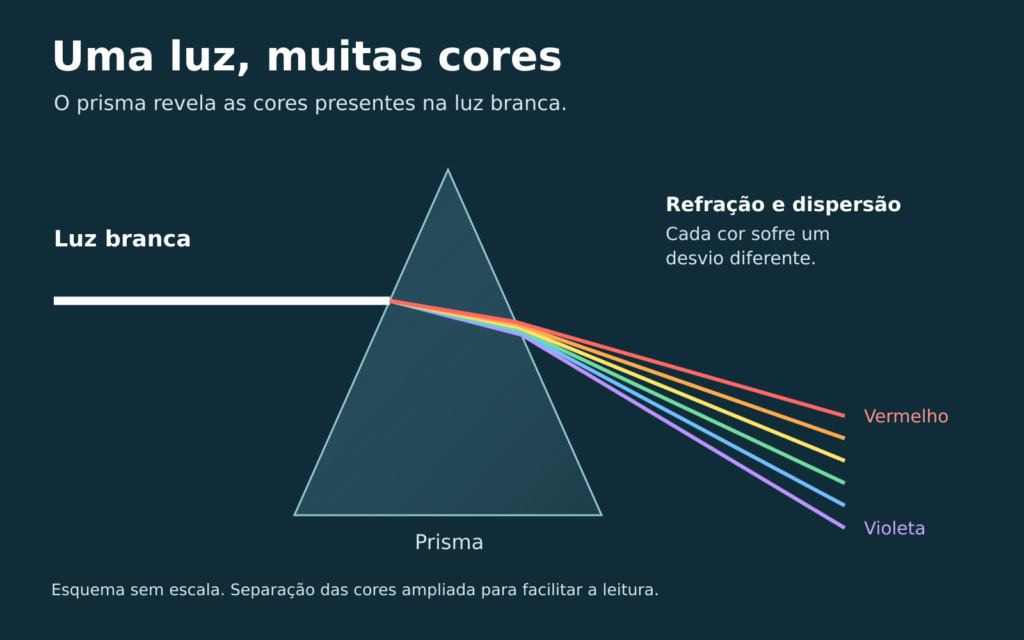
A transparent glass or acrylic prism may have a triangular cross-section. When light passes from air into that material, its speed changes. If it meets the surface at an angle, its direction also changes. This bending is called refraction.
The material does not bend all wavelengths equally. In ordinary prisms, violet light is deflected more than red light. On leaving the other face, light undergoes another refraction and the directions separate further. This separation of colors is called dispersion.
A prism therefore does not make colors or dye the light. It separates components already present in the beam. Isaac Newton’s prism experiments helped establish this idea.
A useful distinction: refraction is the change of direction as light passes between media; dispersion is the difference in bending between its components. A single-color beam can be refracted without producing a multicolored band.
Inside the drop: entry, reflection, and exit
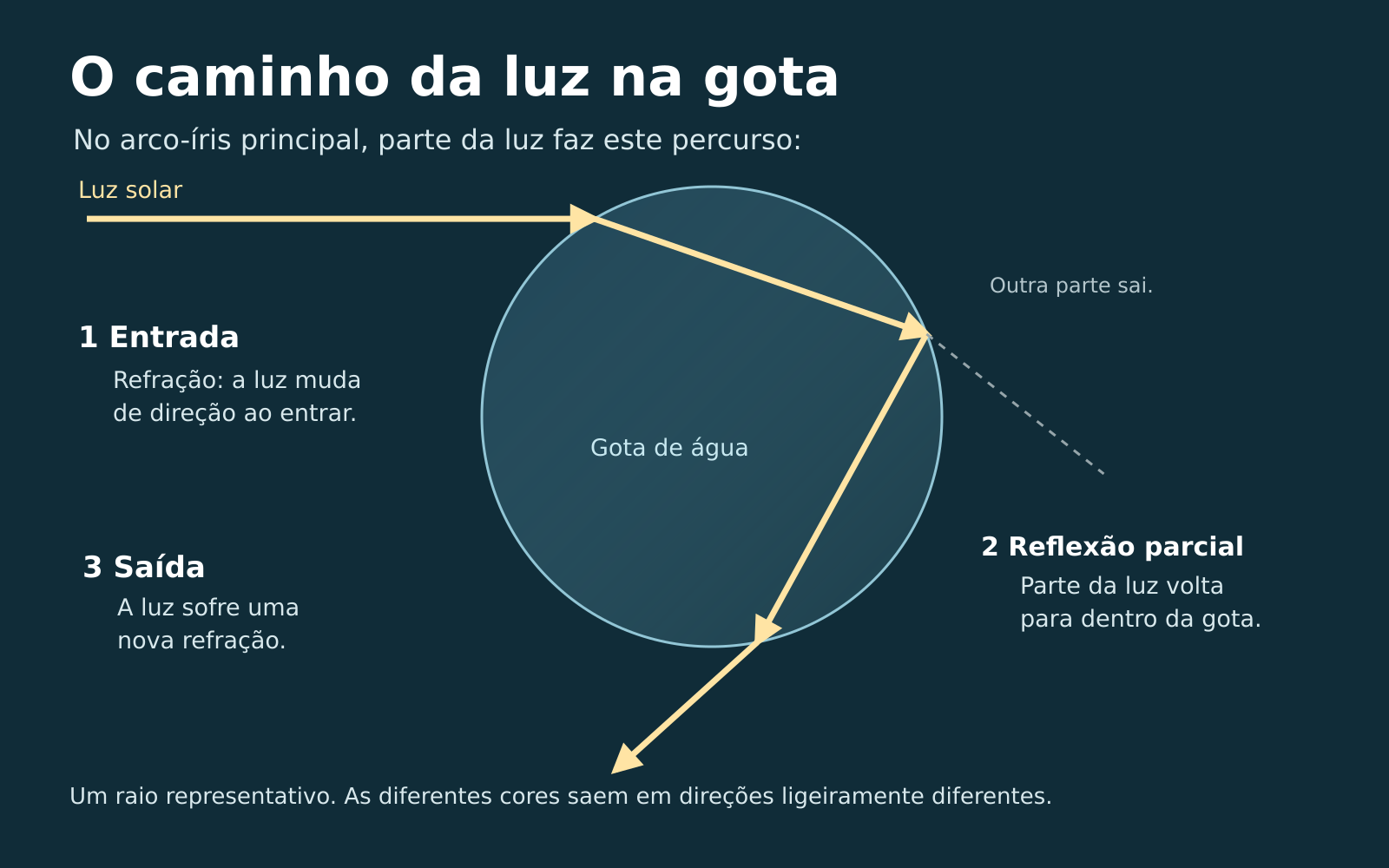
The prism comparison helps, but has a limit: small drops are approximately spherical, not triangular. To form the primary rainbow, light reaching the observer follows three stages:
1. It enters the drop. Passing from air into water causes refraction. Because bending depends on wavelength, the colors begin following slightly different paths.
2. It reflects once inside. At another part of the surface, some light returns into the drop. Another portion passes through the surface and follows a path that does not form the primary bow.
3. It leaves the drop. Passing from water into air causes another refraction. The angular separation between colors sends them in different directions.
Reflection changes the ray’s course; color separation is associated with refraction and dispersion. A drop is not a perfect mirror, and this internal reflection is partial.
Why do we see an arc rather than a patch of colors?
Millions of drops receive light at once, but they do not all send the same color toward our eyes. The path inside each drop concentrates primary-rainbow light in certain directions.
Imagine a line from your eyes toward the point in the sky directly opposite the Sun: the antisolar point. The strongest red appears about 42° from that direction, and violet about 40°. These are viewing angles, not distances to the bow.
Looking in all directions that make the same angle with that line traces a circle. Because red appears at the larger angle, it lies on the primary bow’s outer edge; violet is on the inner edge. Each band we see receives light from many drops in different positions.
Why does it seem to move?
A rainbow depends on the combination of Sun, drops, and observer. Walking changes that geometry, so light starts reaching you from other drops. That is why you cannot reach a fixed point where the bow “touches” the ground.
Two people standing side by side see very similar bows, but the light reaching them does not come from exactly the same set of drops. The phenomenon is real; its apparent position depends on the observer.
People on the ground usually cannot see the complete circle: the terrain blocks part of the view, and illuminated drops may not exist in every necessary direction. From an aircraft or an elevated viewpoint, favorable conditions can reveal more of the bow or even the whole circle.
What about double rainbows?
The secondary bow comes from rays undergoing two internal reflections before leaving the drops. It appears outside the primary bow and is usually fainter. Its color order is reversed: red on the inner edge and violet on the outer edge.
Between the two bows, a strip of sky may look darker. Less light from the paths producing the primary and secondary bows reaches this region. It is called Alexander’s dark band.
Observing and experimenting safely
To look for a rainbow, keep the Sun behind you and look toward illuminated drops ahead. It may appear while rain is still falling elsewhere. A low Sun generally favors a higher bow. Never look directly at the Sun, with or without a prism.
To explore dispersion at home or school, use a transparent prism, a white-light flashlight, and white paper. In a dim room, let a narrow beam pass through a small gap between two cards, strike one prism face, and reach the paper. Turn the prism slowly until a band of colors appears. Its clarity depends on the light, gap, and prism material.
Compare the result with the explanation: where does the beam change direction? On which side does red appear? This activity demonstrates dispersion but does not reproduce a rainbow’s circular geometry. Do not use a laser or direct intense light toward anyone’s eyes.
In the garden, use raindrops or a fountain already running to observe from a safe place. There is no need to waste water to create the effect. If there is thunder, leave the observation for later and seek shelter.
Sources and further reading
Florida State University: refraction and dispersion in a prism
OpenStax: dispersion, rainbows, and prisms
University of St Andrews: light paths and rainbow geometry
NOAA/NASA: primary and secondary rainbows
Met Office: continuous colors and rainbow varieties
Original Projeto Jardinando illustrations produced with AI assistance. Schematic diagrams, not to scale. Color separation in the prism is exaggerated for clarity.