A lake can turn green when tiny algae multiply in the water. Their growth is often encouraged by excess nutrients, such as those carried in sewage or in rainwater running off fertilized ground.
This enrichment of water with nutrients is called eutrophication. To understand the problem, follow the chain: where the nutrients come from, what they do in the lake, and why they can affect fish and other living organisms.
What turns the water green?
Microscopic algae live in water and carry out photosynthesis: they use light to make their own food and release oxygen in the process. When they become very abundant, they can change a lake’s color and clarity.
Cyanobacteria can also contribute. These photosynthetic bacteria may resemble algae in the water. Some produce toxins, substances that can harm health.
A rapid, substantial increase in algae or cyanobacteria is called a bloom. Eutrophication therefore describes nutrient enrichment, while a bloom is one possible response. Color alone does not tell the whole story.
How do nutrients reach a lake?
Nitrogen and phosphorus are nutrients needed by living organisms. They are also found in many fertilizers. Problems arise when enough enters the water to encourage excessive growth of algae and cyanobacteria.
Imagine a fertilized garden beside a lake. After heavy rain, some fertilizer and soil may wash into the water. Fertilizer does not have to be poured directly into the lake for those nutrients to reach it.
Other common sources include inadequately treated sewage, which carries nutrients and waste; soil washed away by rain, especially from bare ground; and excess animal feed or organic debris, such as accumulated leaves that decompose in the lake.
Eutrophication can happen naturally over time, but human activities can speed it up. Nutrients tend to accumulate in lakes with slow water turnover. Light, temperature, and water circulation also influence the organisms’ growth.
How can this harm fish?
The problem is not just appearance. One important consequence is a reduction in the oxygen available to aquatic life. The sequence has four main stages:
1. More nutrients enter the water, encouraging algae and cyanobacteria to multiply.
2. These organisms become more abundant, potentially making the water green and less clear.
3. Some die and decompose. Many microorganisms consume oxygen from the water as they break down this material.
4. If oxygen use exceeds replenishment, oxygen becomes scarce. Fish and other animals may become ill or die.
Fish breathe oxygen dissolved in water. This is oxygen gas present among the water molecules, not the oxygen that forms part of the H₂O molecule itself.
Don’t algae produce oxygen?
Yes, when there is light for photosynthesis. But they also respire and consume oxygen, both day and night. In darkness, photosynthetic production stops while respiration continues. Decomposition of dead organisms adds another demand for oxygen.
A lake may therefore have plenty of oxygen in the afternoon and little near dawn. Warm water holds less dissolved oxygen, and deeper areas may receive little replenishment when water layers hardly mix. A single measurement at one time and place may miss part of the problem.
The USGS explains how dissolved oxygen supports aquatic life.
Is green water always toxic?
Not all green water contains toxins. Some cyanobacteria can produce them, but color or a photograph cannot confirm their presence. A risk may also exist without a visible surface patch.
If the water looks like spilled paint, has an unusual scum, or smells strongly, avoid contact and keep children and animals away. Do not use it as drinking water for animals or to irrigate food crops. Check local advisories and notify the person responsible for the lake or the environmental authority.
Dead fish also deserve attention. Low oxygen is one possible cause, but other contamination must be considered. Record the date, appearance, and any recent changes, taking photographs from a safe location.
What helps prevent and address the problem?
The first step is to identify and reduce nutrient inputs. This may require sewage treatment, appropriate fertilizer use, protection of the shoreline, and measures to prevent rain from washing soil into the lake.
For an ornamental pond, start by looking at everyday practices. Is the amount of feed appropriate for the animals, or does food remain in the water? Are leaves and other debris accumulating? Does rainwater carry fertilizer or garden soil into the pond?
Adjusting feeding and carefully removing debris can reduce further nutrient inputs. If the change persists, there is a bad smell, or fish are dying, seek a professional assessment before choosing a treatment.
Aeration equipment, which helps increase oxygen in the water, can be useful in some projects. It does not, by itself, remove excess nutrients. Algae-killing products also require care: they may affect other organisms and leave more material to decompose.
Recovery can take time. Even after new inputs are controlled, nutrients stored in bottom mud may return to the water. Clearing the surface does not necessarily resolve the cause.
How can testing establish what is happening?
An assessment combines the lake’s history with water testing. Specialists investigate potential nutrient sources and measure factors such as temperature, clarity, and dissolved oxygen. Chlorophyll, a pigment used in photosynthesis, helps estimate the abundance of algae and other photosynthetic organisms. It does not, on its own, indicate whether toxins are present.
You may also encounter terms such as the Trophic State Index, which helps assess nutrient enrichment, and the Water Quality Index, known as IQA in Brazil, which combines several water-quality measurements.
These indices have limits: a favorable rating does not guarantee that water is safe for drinking or swimming. Where toxins are suspected, specific tests may be needed. The assessment should address the local problem and the intended use of the water.
In short: green water can indicate abundant algae or cyanobacteria. Caring for a lake means looking beyond its color: understanding where nutrients come from, assessing the risks, and tackling the cause.
Sources and further reading
EPA: excess nutrients and their effects on water
ANA: water-quality indicators
CDC: recognizing a potentially harmful algal bloom
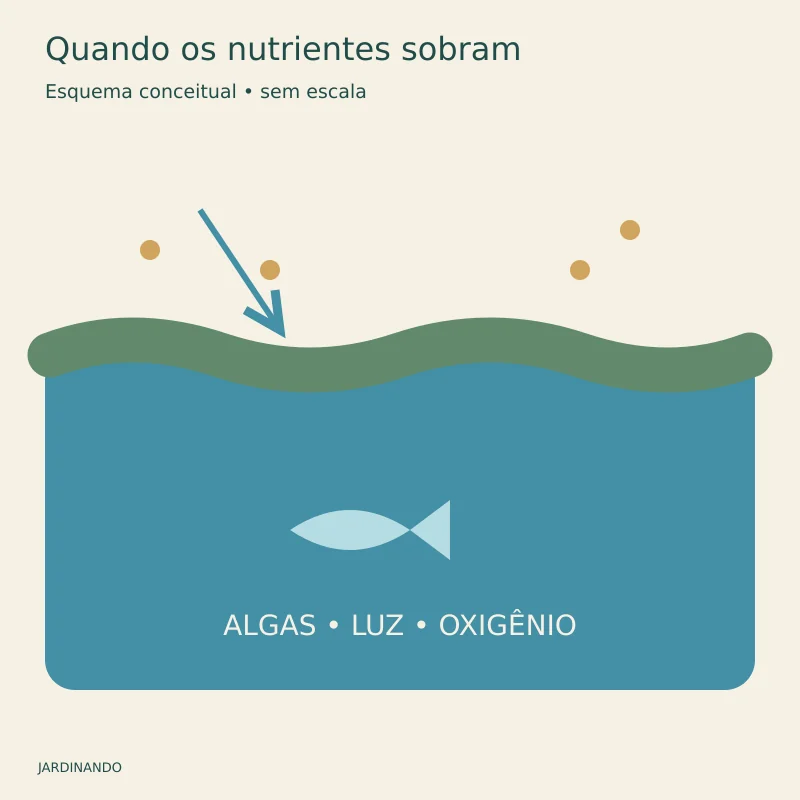
Cover image: When nutrients become excessive. Original AI-assisted illustration; conceptual diagram, not to scale.