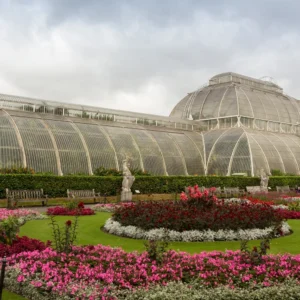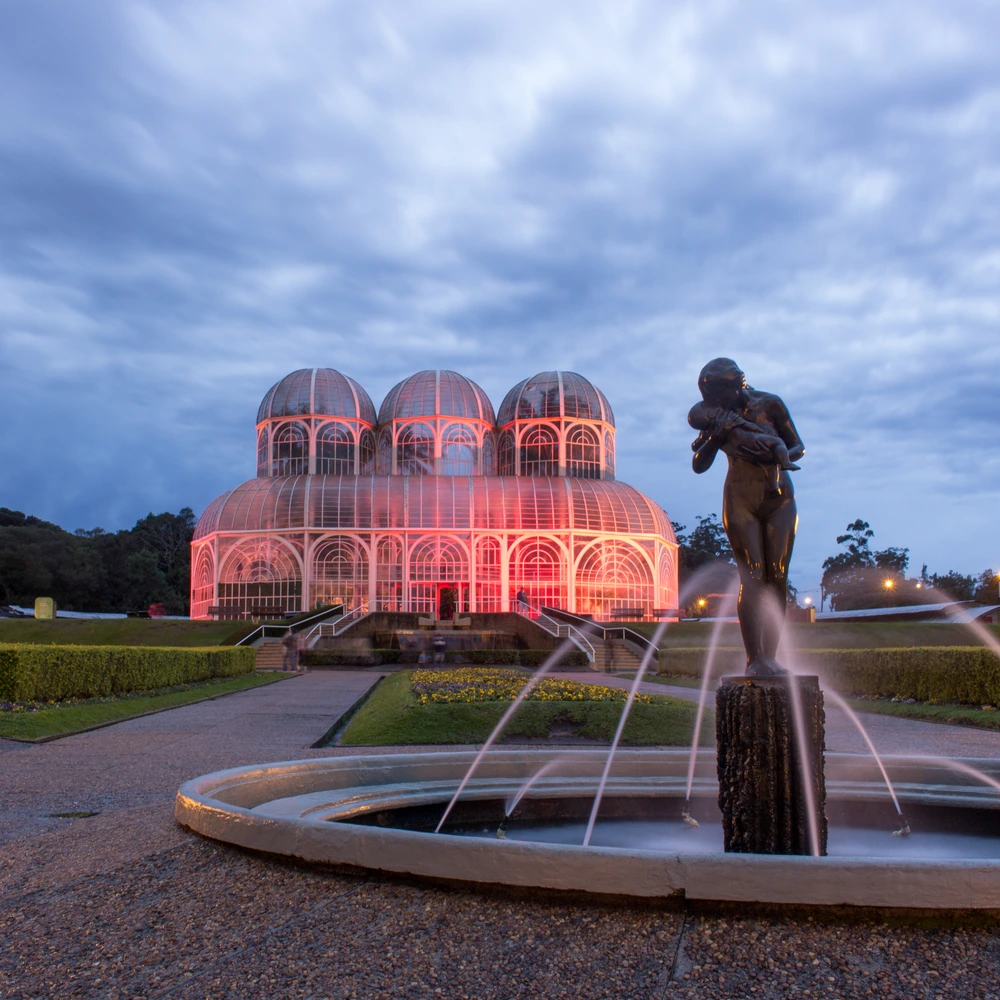
The glasshouse is usually the first image associated with the Curitiba Botanical Garden, in southern Brazil. Yet the paths, plant collections, regional vegetation and scientific work give the visit greater depth. For gardeners, it is a chance to compare ways of arranging and understanding nature.
This article looks beyond the postcard: the garden’s history, spatial design, herbarium and opportunities for observation can inspire ideas at home. A botanic institution is not, however, a catalog of plants ready for every backyard.
A garden opened in 1991, with an older scientific story
The garden opened on 5 October 1991 and was named after Francisca Maria Garfunkel Rischbieter, known as Franchette, in recognition of her contribution to Curitiba’s urban planning. Its glasshouse, geometric beds and conservation areas became a familiar image of Paraná’s capital. Source: the municipal environment department.
Such a striking building helps orient a visit, but can also monopolize attention. Photograph the familiar view, then put the phone away briefly. Notice how beds guide the eye, how vegetation reads from different distances and how visitors move through the paths.
The scientific history has its own timeline. The Municipal Botanical Museum was founded in 1965 and has occupied the garden area since 1992. It originated in the botanical collection of Gerdt Guenther Hatschbach, acquired by the municipality. Research did not begin with the postcard landscape. Read the museum’s history.
What the formal gardens reveal about composition
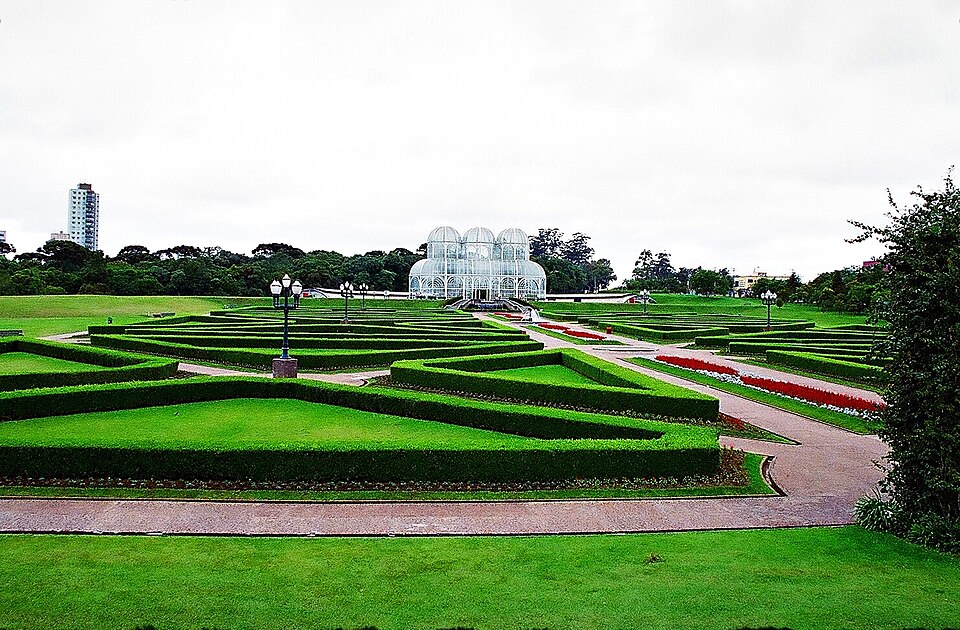
Near the glasshouse, compare path lines with planting edges. Repetition and alignment relate the parts to one another. The city describes references to French gardens and Curitiba’s flag. The useful exercise is to see how those lines work in space, not merely attach a style name.
Close up, an edging plant is an individual specimen; from farther away, many plants become a line. This change of scale matters in design. A species can have interesting flowers while also defining a surface. Individual form and the effect of the group are different things.
From an authorized viewpoint, compare both sides of a path. Repetition creates unity, yet differences in light, growth and flowering remain. A geometric garden is still made of living organisms. Design must accommodate time and maintenance rather than behave like an unchanging drawing.
The glasshouse as a focal point
Its three vaults are recognizable from different viewpoints. Notice how much of the building appears between planting and paths, and how the sky contributes. Architecture can be the main feature without every plant demanding attention. Supporting elements often make the approach to a focal point clearer.
The fountain and the sculpture Amor Materno can be read in the same way. Compare a centered photograph with a side view from a permitted area. The latter may reveal depth and relationships lost in a frontal composition. There is no single correct image; each position includes and excludes something.
From glasshouse to collections: distinguish the growing environments
The municipality describes the glasshouse as housing plants associated with the Atlantic Forest. A protected structure creates conditions unlike an open bed or balcony. A plant’s presence in Curitiba does not prove it can survive the city’s winter outdoors without protection.
Observe light through the glass, leaf spacing and routes for people. Which plants occupy the lowest layer and which create tall volumes? These details help explain the environment without touching the collection. Local labels and guidance are more reliable than guessing from appearance.
Outside, look for collections representing regional flora. A municipal report marking the garden’s 2023 anniversary described native grasslands, araucarias, Brazilian palms and threatened species among its themes. There is more to notice than the brightest flowers. See the city’s account of the collections.
Quieter-looking vegetation rewards attention to forms, rhythms and seasonal change. Ornamental value does not always depend on intense color. Read collection signs: representing a habitat, grouping related plants and displaying threatened species are different aims.
Why the herbarium matters, even outside the tourist route
A herbarium preserves prepared, identified specimens for study. At the Municipal Botanical Museum, dried and pressed plants form a documented scientific collection. The institution also maintains bibliographic information and exchanges material with other collections. Research consultation requires an appointment, according to its official page.
Conserving knowledge is not just keeping a plant alive in a bed. Records allow specimens to be compared and flora to be studied through time. A travel photograph can spark interest, but does not replace a scientific specimen or authorize taking material from the garden.
Simply recognizing this work enriches a visit. A label represents investigation behind the identification. If you have a question about a plant at home, use appropriate advice channels rather than assuming any member of staff can immediately provide a technical identification.
A slower observation route
Begin with the overall view and then move to details. Give separate attention to bed geometry, architecture and collections. With limited time, choose fewer stops. The quality of observation depends more on attention than on the number of photographs.
At the first viewpoint: find the line leading your eye toward the glasshouse.
Beside a bed: compare one plant’s shape with the effect of many.
In a collection: read a sign and identify what brings the specimens together.
Near denser vegetation: compare shade without leaving permitted paths.
Before leaving: record one idea for home and one question to investigate.
The Jardim das Sensações, or Garden of Sensations, offers another approach. Follow its particular instructions, including what may be touched. An organized sensory activity does not give permission to handle specimens elsewhere. Check its operating arrangements separately from the garden’s general hours.
With children, suggest simple contrasts: broad and narrow leaves, light and deep shade, straight and curved lines. Do not turn the activity into collecting leaves or flowers. Photographs, sketches and notes preserve discoveries without removing anything.
Photograph without damaging the collection
Stay on paths when framing the glasshouse and beds. Do not step into planting to remove people from a picture or lie on flowers for a portrait. Repeated small damage harms both composition and growth. A side view or waiting for a clear path usually works better.
Before setting up equipment, organizing a photo session or making commercial images, confirm current rules with the administration. The museum page provides institutional contacts and guidance. Free admission does not authorize every activity.
Keep an appropriate distance from wildlife. Do not feed animals or approach nests for a better picture. Choose compositions that respect other visitors’ privacy. This is a shared space used at different paces and for different reasons.
Where to check access, hours and conditions
The city lists the main entrance at Rua Engenheiro Ostoja Roguski, 350, in the Jardim Botânico neighborhood, and tourist admission as free. Check the official visitor page before travelling, since access and operating arrangements can change.
Do not confuse general opening hours with each facility’s schedule. The glasshouse, sensory garden, educational activities and services may operate differently. An April 2026 notice about temporary glasshouse cleaning illustrates why maintenance matters; it is historical context, not a claim of a current closure.
The municipality identifies a ramp behind the glasshouse. For specific access needs, confirm the route and conditions in the areas you intend to visit. Information about one facility should not become a promise of uniform accessibility across the whole garden.
Consider the weather forecast and dress for walking. Rain or adverse conditions can interrupt activities. Plan the return journey, check rules for bicycles and other items, and take your waste away. Municipal transport links on the garden page can help with public-transport planning.
Three ideas to adapt at home
Repeat a form without excessive maintenance. A short sequence of similar pots can create order. Before choosing borders needing frequent clipping, consider the time available. In a compact space, rhythm can come from containers and placement rather than reproducing formal beds maintained by a dedicated team.
Choose for the actual climate. Regional flora can inspire, but sun, soil, drainage and adult size still matter. “Native to Brazil” does not mean suitable for every Brazilian climate, much less every country. Buy legally sourced plants and ask for the precise species. Do not take seeds, cuttings or plants from places you visit.
Create a comfortable sensory corner. Choose a few plants with known texture and scent that suit the available light. Check toxicity and suitability around children and pets before buying. Not every aromatic plant is edible, and touching or smelling may bother sensitive people. Contact should never be compulsory.
A home garden does not need a glasshouse to recall Curitiba. A clear route, one focal point and a small, well-chosen collection may translate the visit more successfully. Our step-by-step landscape design guide helps turn those ideas into a practical plan.
Frequently asked questions
Is there an admission charge? The city lists tourist entry as free. Check the official page for your date and any particular activity or service, rather than assuming everything is included.
Is the glasshouse the whole visit? No. Gardens, collections, education and research are also part of the site. Give regional vegetation and different planting approaches some attention.
Can I walk freely into the herbarium? Research access requires an appointment with the museum team. It is different from visiting open tourist areas.
Can every glasshouse plant grow in any Curitiba garden? Not necessarily. Protection changes growing conditions. Check the species and your own space before buying.
Sources and photographs
The article is based on the linked municipal sources. General visitor information was checked again on 17 November 2026; historical notices are identified as such. Observation exercises and home-garden ideas are Projeto Jardinando’s editorial suggestions. Reconfirm operating details before visiting.
Featured image: Estufa principal do Jardim Botânico de Curitiba 01, Rodrigo.Argenton, via Wikimedia Commons, CC BY-SA 4.0. Square crop, resizing and WebP conversion. The image adaptation remains under the same license.