Images of mining dredges being destroyed can make an environmental operation look like a single dramatic moment. The underlying questions are more important: what activity was illegal, why could the equipment not be removed, and what prevents it from being used again?
Jurisdiction note: the enforcement rules discussed here are Brazilian federal law. They do not establish the rules of another country. Readers outside Brazil should consult their own environmental authority and applicable legislation.
The following account separates documented Brazilian enforcement actions in September and October 2026. A clip circulating later on social media should not automatically be assigned to the newest operation.
Four documented actions
Hidra Dourada, 21–25 September: Brazil’s Federal Police and Ibama operated along the Madeira River between Autazes and Novo Aripuanã, Amazonas. The police report records the destruction of 22 gold-mining dredges and five support vessels. Investigators also sought evidence about the operation’s financial and logistical chain.
Nêmesis, 27 October: between Calama and São Carlos in Rondônia, authorities disabled 72 vessels and pieces of equipment. The official breakdown was 17 dredges, two tugboats, three small motorboats, 21 engines, 25 dredge pumps and four water pumps. It was not a total of 72 dredges.
Nêmesis, second phase, 30 October: the Federal Police statement describes unlicensed dredges upstream of Jirau dam. It says properly authorized areas were not targeted. The structures could not be removed because suitable towing and storage were unavailable.
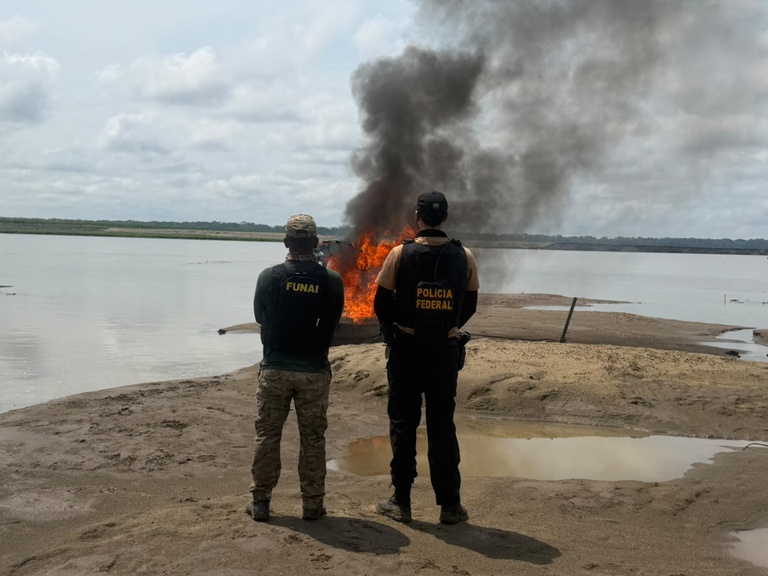
Aurum, 30 October: Federal Police, Ibama and Funai acted near Santa Rita do Weill in the Upper Solimões region. The official tally combines seizures and disabling of equipment. Because it does not specify the fate of every item, it does not support saying that everything listed was destroyed.
Video of Operation Hidra Dourada
The video below, also included in the Portuguese article, shows Operation Hidra Dourada and was published by Amazonas Atual. It relates to the September action, not the October phases of Nêmesis. The original video is in Portuguese, without added dubbing or subtitles.
Is removal cost the whole explanation?
No. Transport, storage, safety and the possibility of renewed illegal use all matter. The second Nêmesis report places the structures about 27 km upstream of the dam; it provides no cost comparison. It also reports removal of mercury and other harmful substances before disabling the dredges. Those details explain this action, not every enforcement operation.
What does the legal rule say?
Article 111 of Brazil’s Decree 6,514/2008 permits destruction or disabling when necessary to prevent improper use and transport and storage are impracticable, or where the items create significant environmental or safety risks. It requires documentation of their condition before and after the action and their valuation. These are federal Brazilian criteria, not a legal test for enforcement in other countries; consult the relevant authority in the jurisdiction concerned.
Seizure and destruction are therefore not interchangeable. A legal provision does not replace the need to document the circumstances of the particular case. This overview concerns Brazilian rules and does not describe the law in other countries.
Why the context matters
The public-interest question goes beyond whether a video is striking. To evaluate enforcement, readers need an identifiable operation, a dated account, an explanation of the equipment’s disposal and evidence of follow-up. A short clip cannot show the entire inspection or establish what happened to every seized asset.
These reports should be read as records of specific actions, not proof that all mining is illegal or that every confiscated machine must be destroyed. Keeping those distinctions clear makes discussion of environmental protection more informative and less dependent on isolated images.
Cover image: Operation Aurum, Alto Solimões, 30 October 2026. Federal Police / Press release, CC BY-ND 3.0. Reproduced in full, without modifications.