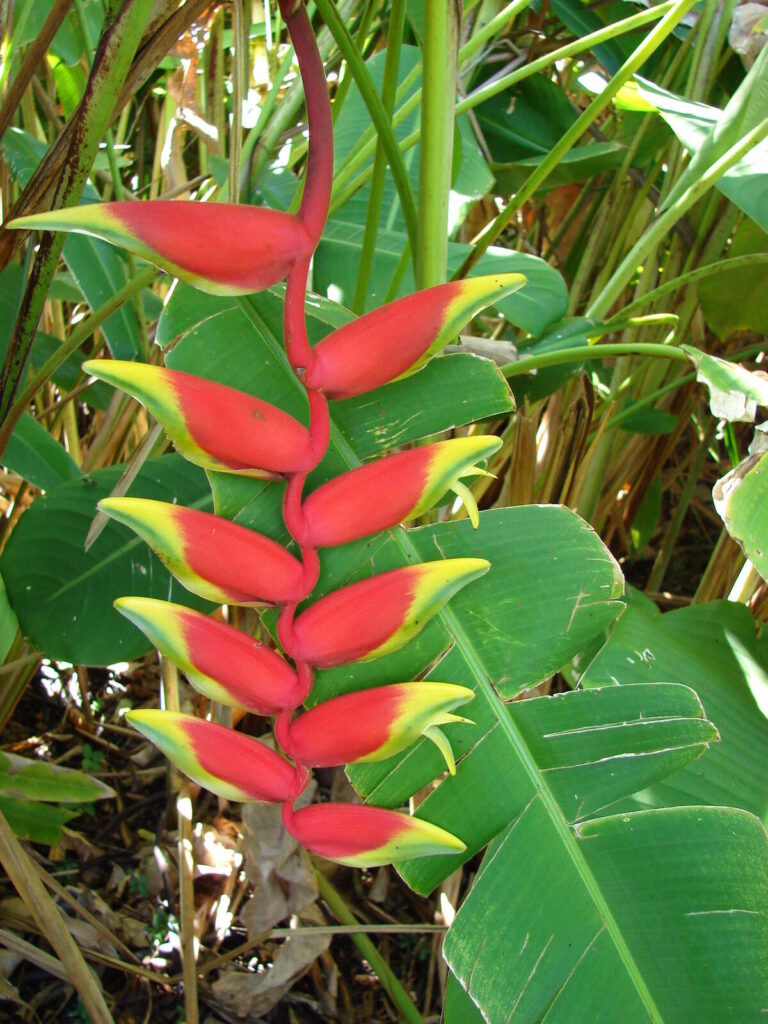
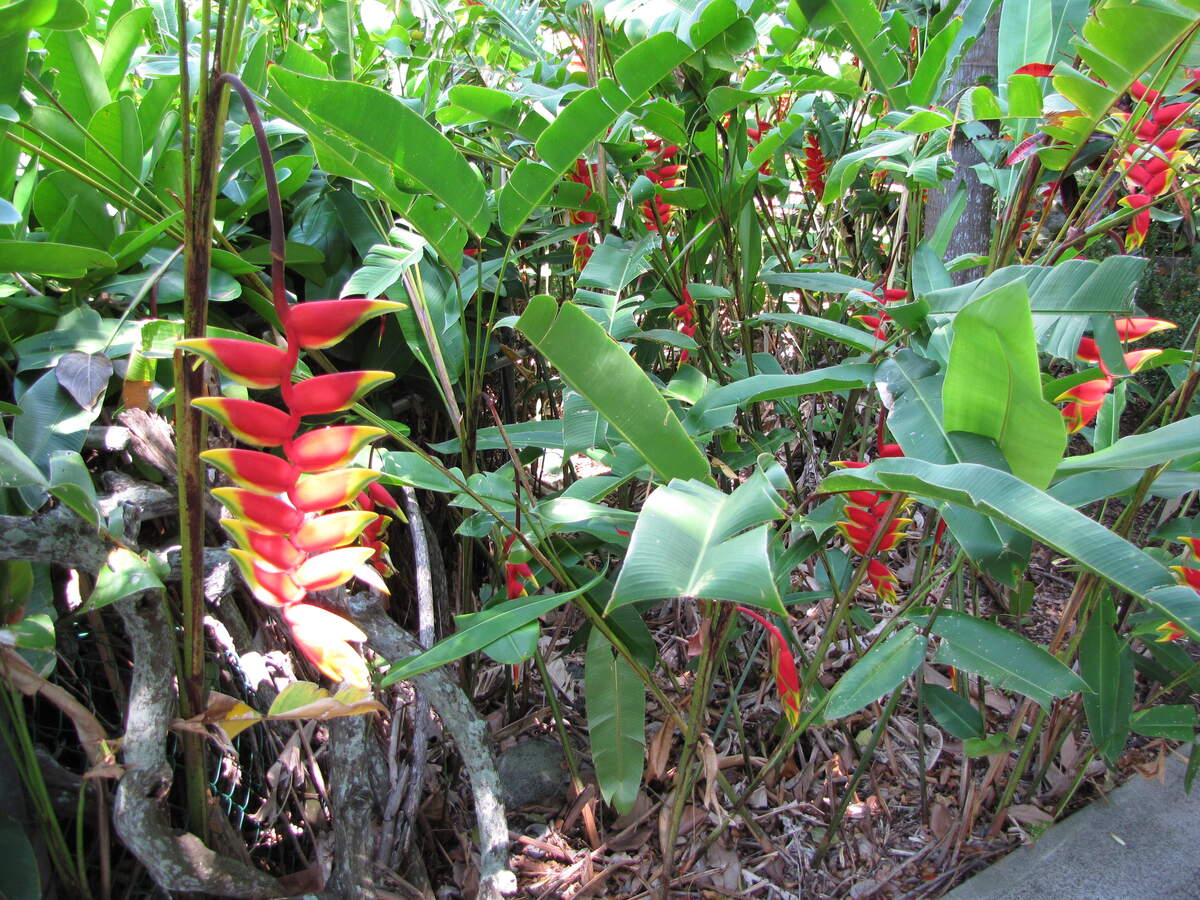
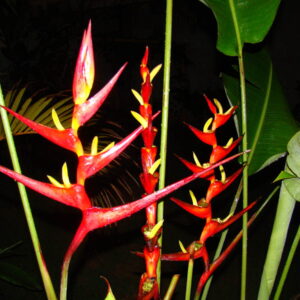
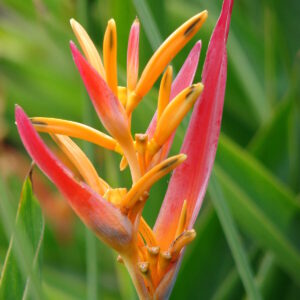
A hanging chain of red and yellow bracts is the unmistakable attraction of Heliconia rostrata. Known as hanging lobster claw, it gives a tropical garden a striking focal point. Its broad leaves are attractive too, but a young nursery plant can make you underestimate the space a mature clump needs.
A heliconia, not a banana plant
The Brazilian name bananeira-ornamental refers to its banana-like appearance, not its botanical identity. Kew places the species in Heliconiaceae and lists its native range in western South America: Bolivia, Colombia, Ecuador and Peru. The leaves arise from a perennial plant with underground rhizomes.
What looks like a string of colourful flowers is largely made up of bracts, with smaller flowers inside. USP describes the hanging display and its association with hummingbird pollination. Choose a position where those descending stems will be visible rather than hidden behind another dense shrub.
Allow room for the foliage and the hanging flower stalks. Photo: Forest & Kim Starr, CC BY 3.0 US; resized and compressed.
Light and climate come first
NParks lists full sun or partial shade. That offers flexibility, not a reason to move a shade-grown plant straight into fierce afternoon sun. Assess local heat, the nursery conditions and the bed itself. In an exposed garden, choose shelter from strong winds so the large leaves are less likely to be shredded.
Cold is a more serious limitation than a slightly imperfect planting position. UF/IFAS guidance for northern Florida warns against relying on this tropical species outdoors through cold winters. Where frost occurs, plan suitable protection or choose a hardier plant; surviving one mild season does not establish winter hardiness.
Watering, growth and division
Use fertile soil that holds moisture but drains. Check it before watering, especially after rain. A large container can work only if it provides room for the rhizomes and an escape route for excess water. Avoid treating a permanently wet pot as proof that a tropical plant is well cared for.
UF/IFAS lists division as the propagation method and notes that flowering stalks arise in their second year. Do not repeatedly cut every healthy shoot down while waiting for flowers. Divide healthy established clumps with clean tools, keeping substantial viable rhizome sections. For feeding, follow the fertiliser label rather than an automatic monthly dose.
Leave maintenance access around the clump. Use it to soften a wall, not to obstruct equipment that must remain accessible. If the space is limited, compare its form with Heliconia psittacorum, checking the actual cultivar rather than assuming every heliconia stays compact.
Cut flowers: keep the base wet, not the whole display
Embrapa recommends harvesting in cooler hours and keeping stems hydrated in clean water. Its post-harvest guide specifically excludes rostrata from immersing the whole inflorescence because of its hairy surface. Handle the bracts gently and keep the cut stem bases supplied with water. Old commercial chemical-treatment recipes are not included here as home-use advice.
Usamos cookies em nosso site para fornecer a melhor experiência de uso, lembrando suas preferências e visitas repetidas. Ao clicar em “Aceitar”, concorda com a utilização de TODOS os cookies.
Este site usa cookies para melhorar sua experiência enquanto você navega pelo site. Destes cookies, os cookies que são categorizados como necessários são armazenados no seu navegador, pois são essenciais para o

funcionamento das funcionalidades básicas do site. Também usamos cookies de terceiros que nos ajudam a analisar e entender como você usa este site. Esses cookies serão armazenados em seu navegador apenas com

o seu consentimento. Você também tem a opção de bloquear esses cookies. Porém, a desativação de alguns desses cookies pode afetar sua experiência de navegação.
Os cookies necessários são absolutamente essenciais para o funcionamento adequado do site. Esta categoria inclui apenas cookies que garantem funcionalidades básicas e recursos de segurança do site. Esses cookies não armazenam nenhuma informação pessoal.
Quaisquer cookies que possam não ser particularmente necessários para o funcionamento do site e sejam usados especificamente para coletar dados pessoais do usuário por meio de análises, anúncios e outros conteúdos incorporados são denominados cookies não necessários. É obrigatório obter o consentimento do usuário antes de executar esses cookies no seu site.