Buriti (Mauritia flexuosa), also known as the moriche palm, is one of the most recognisable palms of tropical South America. Its tall trunk and fan-shaped crown stand out above wet landscapes, but its importance goes well beyond appearance: fruit, fibres and wildlife habitat connect it to the daily lives of many communities.
Recognising the palm
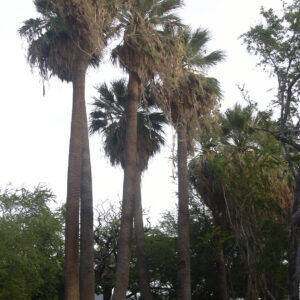
Buriti belongs to the Arecaceae family and has a single trunk topped with large, fan-shaped leaves. These are not feather-shaped fronds. The fruit has overlapping reddish-brown scales surrounding orange pulp and usually one large seed. Regional names include miriti in Brazil, aguaje in Peru and moriche in Venezuela and parts of Colombia.
It is a large landscape palm, not a small container plant. Embrapa references describe mature specimens reaching several tens of metres. Before considering it for a property, look at the space above and around the planting area, access for maintenance and the site’s water conditions.
Why water and habitat matter
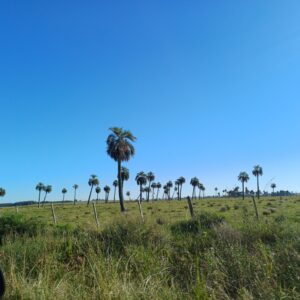
Buriti is closely associated with wetlands, stream margins and the wet valleys known as veredas in Brazil’s Cerrado. A region may have a dry season while the palm’s roots still have access to water. That is very different from saying that it is suitable for dry garden soil without irrigation.
Embrapa’s account of buriti in the Cerrado describes its relationship with blue-and-yellow macaws: the birds feed on the fruit and use dead palms for nesting. A palm that looks unproductive to a person may therefore still have ecological value.
Wetland adaptation does not mean that any alteration to water flow is harmless. Embrapa Amapá’s study of buriti and its uses records damage where road drainage problems left water stagnant for long periods. Conserving a buriti grove means looking after the surrounding water system, not just the trunks.
Fruit, food and craft traditions
The orange pulp is used in regional drinks, sweets and ice creams. Oil extracted from the fruit is also used in food and cosmetic production, while fibres and leaves support craft traditions. These uses help explain why conserving the palm can matter to local livelihoods as well as wildlife.
The fruit’s carotenoids and oil content are reasons for nutritional and processing research, not a basis for promising that it prevents or treats disease. Cosmetic use likewise does not make a homemade preparation equivalent to a tested skin treatment. When buying food products, prefer clearly identified producers and appropriate processing and storage rather than assuming a freshly collected wild fruit is ready to eat.
Male and female plants: an important detail
Buriti is dioecious: male and female flowers occur on separate plants. Fruit production depends on female plants and pollination; planting one unidentified seedling does not guarantee a future harvest. The sexes are not easily distinguished from ordinary vegetative features before flowering.
The buriti chapter in Plantas para o Futuro reports variation in the age of first flowering. It is better to plan for a long establishment period than to promise fruit in an exact year. A productive planting also needs a layout that takes pollination into account.
Planning a planting rather than copying a recipe
The same chapter discusses spacings of 8 × 8 m to 10 × 10 m in a production context. Those numbers are not a universal prescription for restoring a wetland, designing a garden or managing an existing grove. Soil, water availability, planting objectives and the future size of the palms all matter.
For a small, dry urban garden, another species may be a better fit. For restoration or fruit production, get a locally suitable plan before buying seedlings or changing the land. Do not drain a natural wet area to make it resemble an ordinary ornamental bed.
Raising seedlings
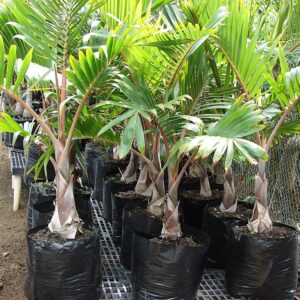
Buriti is propagated from seed. The Embrapa Cerrados nursery manual describes uneven germination, so seedlings do not all become ready for the next stage at once. Healthy seed, suitable nursery conditions and attention to moisture are more useful than expecting a fixed date.
The manual distinguishes nursery management from the conditions occupied by adult palms: seedbeds need moisture without conditions that favour seed decay, and young plants are grown under partial shading. Adult tolerance of wet ground is not a reason to keep every seed tray submerged. Buying an established seedling from a responsible nursery is often simpler for a first planting.
Using the grove without exhausting it
Sustainable use requires leaving the palm able to keep growing and reproducing. Do not fell a female palm to reach its fruit or remove all its leaves for material. Harvesting at height is specialised work, not a task to improvise with a ladder. The Ministry of Agriculture’s good-practice handbook for buriti treats protection, harvesting and monitoring as parts of the same activity.
There is no reason to routinely cut green leaves in the hope of increasing fruit production. Where safety and conservation needs overlap, an experienced local professional should assess the situation. Keeping the wetland functioning, respecting wildlife use and supporting careful local production are practical ways to value buriti beyond its silhouette.
Photo credit
Bernard DUPONT / Wikimedia Commons, CC BY-SA 2.0. Buriti palms on the Comté River, French Guiana. Resized image, shared under the same licence.
Usamos cookies em nosso site para fornecer a melhor experiência de uso, lembrando suas preferências e visitas repetidas. Ao clicar em “Aceitar”, concorda com a utilização de TODOS os cookies.
Este site usa cookies para melhorar sua experiência enquanto você navega pelo site. Destes cookies, os cookies que são categorizados como necessários são armazenados no seu navegador, pois são essenciais para o

funcionamento das funcionalidades básicas do site. Também usamos cookies de terceiros que nos ajudam a analisar e entender como você usa este site. Esses cookies serão armazenados em seu navegador apenas com

o seu consentimento. Você também tem a opção de bloquear esses cookies. Porém, a desativação de alguns desses cookies pode afetar sua experiência de navegação.
Os cookies necessários são absolutamente essenciais para o funcionamento adequado do site. Esta categoria inclui apenas cookies que garantem funcionalidades básicas e recursos de segurança do site. Esses cookies não armazenam nenhuma informação pessoal.
Quaisquer cookies que possam não ser particularmente necessários para o funcionamento do site e sejam usados especificamente para coletar dados pessoais do usuário por meio de análises, anúncios e outros conteúdos incorporados são denominados cookies não necessários. É obrigatório obter o consentimento do usuário antes de executar esses cookies no seu site.