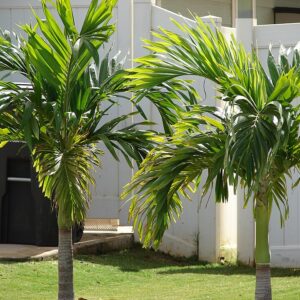
The foxtail palm (Wodyetia bifurcata) gets its name from its full, feathery fronds. Leaflets point in different directions around the central stalk, creating a bushier outline than the flatter leaves of many other palms. It makes a striking feature in a warm garden, provided there is room for the crown as well as the trunk.
What kind of palm is it?
This is a single-stemmed member of the Arecaceae family. James Cook University places its natural range around Cape Melville in northeastern Australia, where it grows among granite boulders. A group sold in one pot consists of several plants, not a naturally branching specimen.
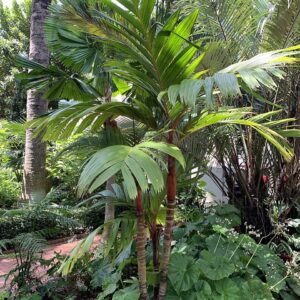
The pale, ringed trunk is topped by a smooth green crownshaft beneath the leaves. White flowers develop below it, followed by fruits that turn orange-red. The leaves are the main ornamental feature, but flowering and fruiting add another stage to the palm’s appearance.
Plan for its mature size
Published sizes differ with growing conditions and the purpose of the reference. The UF/IFAS species profile describes heights around 9 m (30 ft), while NParks records a maximum of 15 m. Do not buy it on the assumption that it will always stop at 10 m.
A UF/IFAS landscape table gives a typical crown width of about 3.7 m (12 ft). Use the expected crown, nearby buildings and access for maintenance to decide spacing. A blanket rule of 2–3 m between trunks does not guarantee separate crowns. Avoid overhead wires and places where falling old fronds or fruit would create a hazard.
Sun, warmth and soil
Choose a bright outdoor position, preferably with full sun. Some partial shade is tolerated, but this is not a palm to put in a dark corner and expect vigorous growth. A container can hold a young specimen, though its eventual size makes it a long-term planning decision rather than a permanent small patio plant.
Treat it as a warm-climate palm, not a reliably frost-hardy one. Brief survival in a cold event does not mean the foliage will remain undamaged. If freezing winters are normal where you live, choose a palm suited to those conditions instead of relying on a single minimum-temperature claim.
Good drainage matters. The UF/IFAS profile favours slightly acidic soil, and its ornamental-palm guide warns that foxtail palms perform poorly in alkaline soils. Before planting into a difficult site, check the soil rather than assuming extra fertiliser will solve every problem.
Watering and feeding
While a young plant establishes, monitor the root ball and surrounding soil. Water the root zone rather than repeatedly wetting the crown. Established plants tolerate some drought, but drought tolerance is not the same as best growth with no irrigation. In pots, keep drainage holes clear and avoid continuously saturated compost.
Yellowing, spotting or distorted new growth deserves investigation before treatment. Foxtail palms are susceptible to potassium and manganese deficiencies, particularly when site conditions interfere with nutrition. Do not automatically cut off the affected leaves or add assorted nutrient products. A local assessment can distinguish a deficiency from drainage problems, cold injury or disease and guide a suitable palm fertiliser programme.
Pruning: usually less is better
Foxtail palms normally shed old fronds themselves. The UF/IFAS pruning guidance specifically includes this species among self-cleaning palms. Do not strip green leaves to make the crown look tidy, and do not force an attached frond loose.
If dead material or fruit clusters pose a risk over a path, arrange safe removal. Work high in a palm belongs with a qualified professional. Removing yellowing leaves without a diagnosis can hide useful symptoms and remove nutrients the plant is still recovering.
Growth and new plants
Growth varies with the starting size, climate, root establishment and care. Descriptions such as “fast-growing” do not establish a fixed annual gain or a guaranteed age for fruiting. Evaluate whether the palm suits the garden at maturity, not whether it will meet a five-year timetable.
Propagation is by seed. NParks gives three to six months as a germination reference, so sowing is a slower route than buying a well-grown nursery plant. Obtain plants or seeds from legitimate cultivated sources; there is no need to collect material from wild populations.
For a different silhouette, compare the Christmas palm before choosing. Comparing mature dimensions and care needs is more useful than selecting solely from a nursery photograph.
Photo credit
ITropically / Wikimedia Commons, CC BY-SA 4.0. Foxtail palms at SeaWorld Orlando. Cropped and resized image, shared under the same licence.