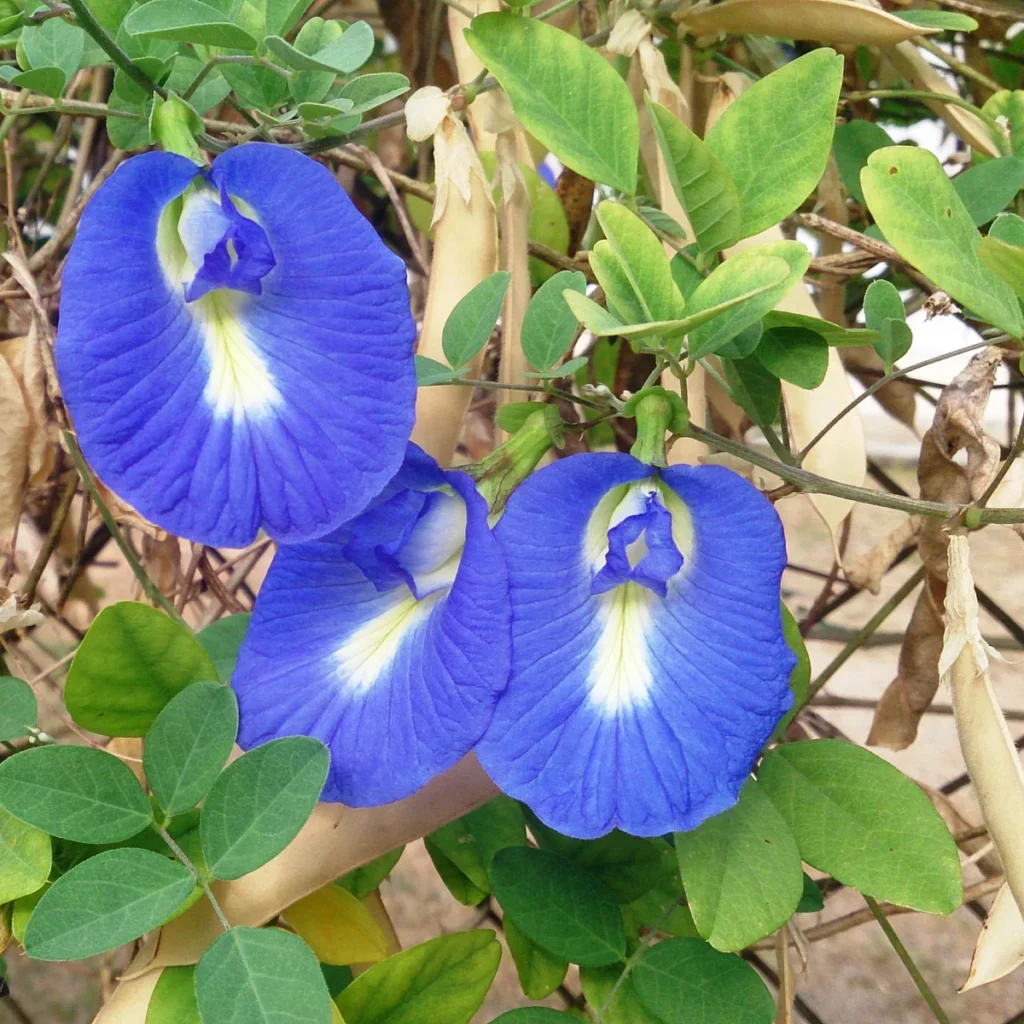
Butterfly pea is a slender climbing plant with showy flowers, often deep blue. Train it over a lightweight support to bring color to a sunny spot.
Plant profile
Scientific name: Clitoria ternatea L.
Family: Fabaceae.
Life cycle: perennial in a suitable climate.
Habit: climber.
Light: full sun to partial shade.
Water: moderate, with good drainage.
How to recognize butterfly pea
Each leaf usually has five to seven smaller sections, called leaflets, and the fruits are elongated pods. White-flowered plants occur alongside blue ones. Check the scientific name when buying seeds: common names vary and are not enough to identify a plant. Singapore’s National Parks Board (NParks) describes these features.
Where to plant and how to train it
Choose direct sunlight and soil that drains freely. Butterfly pea tolerates different soil textures, but this does not mean its roots should remain waterlogged. NC State Extension notes that consistent watering supports growth despite the plant’s drought tolerance. It may be perennial in a tropical climate; in colder regions, its lifespan and performance change.
Install a trellis or use a fence before the stems become tangled. The University of Florida (UF/IFAS) recommends these supports and planting after the danger of frost has passed. Choose planting dates for your own climate rather than copying months from another region’s calendar.
Spread young shoots across the support and secure them loosely with soft ties. Check the ties as stems thicken, and guide new growth into empty spaces. Do not tighten wire around a stem. These are general climber-training guidelines from the Royal Horticultural Society (RHS).
You can also let stems trail from hanging baskets. UF/IFAS Charlotte County describes this use, while noting that the stems can grow quite long. On a balcony, leave enough room to guide growth without blocking a walkway.
Watering, maintenance and problems
Adjust watering to heat, rainfall and soil moisture. Spider mites, whiteflies, anthracnose (a fungal disease) and bacterial soft rot are among the problems recorded by NC State. Inspect new shoots and leaf undersides; this list is not a substitute for identifying a problem before treating it.
Remove dead stems and shorten only those that outgrow the available space. Guiding shoots is often more useful than repeatedly cutting back the whole plant. This is a conservative application of the RHS’s general pruning advice for climbers, not a species-specific recommendation for hard pruning.
Growing butterfly pea from seed
A seed can be alive but slow to germinate. Embrapa describes delayed germination associated with water being unable to pass easily through the seed coat. Adding more water to the potting mix does not solve that barrier. Before treating a batch, check whether the supplier has already prepared the seeds.
For untreated seeds, mechanical scarification means gently wearing down the seed coat with sandpaper. A study published by UFPB obtained good results with this method. At home, work carefully without crushing the seed or exposing its interior, and try a few seeds first. Do not reproduce acid treatments described in research.
After preparation, follow this sowing sequence: choose seeds from a known source; use a container with drainage holes and a seed-starting mix; space the seeds and cover them to the depth recommended by the supplier. Label the date and batch. Provide suitable moisture, air and warmth without waterlogging the mix. Do not place fertilizer directly on seeds. If seedlings do not emerge, check storage conditions, sowing depth and growing conditions before discarding the batch. These are general seed-starting principles from UF/IFAS.
There is no single timetable for the first flower bud. UF/IFAS reports flowers from around six weeks under favorable conditions, but that is not a guarantee for every sowing. Cold, low light and difficulty establishing roots affect the result. As this species can self-seed, collect pods when you do not want more plants, and never discard seeds in natural areas.
Frequently asked questions
Is butterfly pea native to Brazil? The Royal Botanic Gardens, Kew lists the species as introduced in Brazilian regions. Growing spontaneously is not the same as being native.
Why does my plant have leaves but few flowers? First review sunlight, water supply and how well the young plant has settled in. Observe growth over time before trying to solve a lack of flowers with fertilizer.
Are the flowers used in food? NParks records their traditional use as a coloring agent. This ornamental growing guide does not provide instructions for consumption or medicinal use. The shift from blue to pink in acidic conditions, described by NC State, is a property of the pigments, not evidence of a therapeutic benefit.
Photo: Mokkie, CC BY-SA 3.0, via Wikimedia Commons and NC State Extension. Square crop and WebP compression, without upscaling.