White bird of paradise produces large, banana-like leaves and can become an imposing plant in a suitable climate. Even in a pot, it needs room for its foliage to spread.
Plant profile
Scientific name: Strelitzia nicolai.
Common names: white bird of paradise, giant white bird of paradise; confirm the species by its scientific name.
Family: Strelitziaceae.
Origin: southern Africa.
Growth habit: a large, clump-forming perennial.
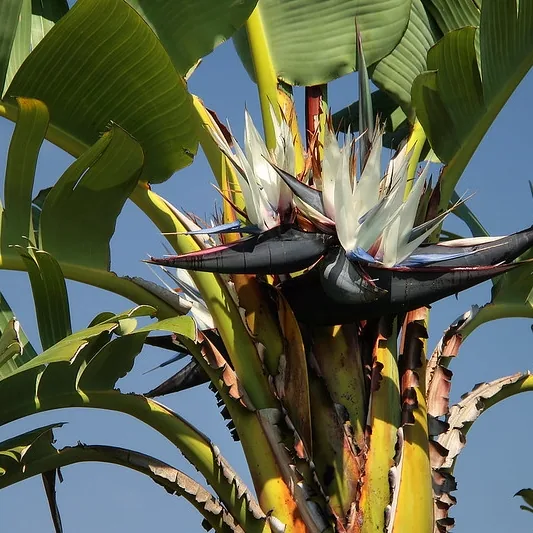
Flowers: white and blue, unlike the orange flowers of other bird-of-paradise species.
Basic growing conditions
Indoors, choose a very bright position. Use a well-drained potting mix and water when the surface begins to dry. Protect the plant from cold, sudden temperature changes and strong winds, which can tear the leaves. It can be propagated by division or seed.
Choosing the pot and position
Allow for the leaves to open out and for future growth, not just the size of a young plant. Indoors, a very bright spot near a large window is preferable. Acclimatize the plant gradually when moving it to a balcony or garden, and seek shelter from strong winds. Keeping this species in a pot does not turn it into a dwarf plant.
Water according to the soil, not a fixed schedule
Light, heat, plant size and pot material all affect how quickly the mix dries. Check the moisture before watering. When water is needed, wet the mix evenly and let the excess drain through the holes. Empty the saucer or outer pot so that the base does not stand in water. If the plant wilts, check the mix before adding more: too little and too much water can cause similar symptoms. These are general principles for watering container plants.
When to consider repotting
Roots at the drainage holes or on the surface are a reason to inspect the root ball, especially if it fills most of the container. The RHS advises moving strelitzias into a pot only slightly larger. Use fresh, well-drained mix, keep the same planting depth and leave a watering gap below the rim. Choose a period of active growth rather than copying a calendar month from another climate.
Looking after the leaves
Gently remove dust and rotate the pot gradually to distribute exposure to light. Take the opportunity to check for mealybugs and scale insects, as well as mites. Provide ventilation without strong gusts. Flowering may take years and depends on growing conditions; indoors, plan the space mainly to enjoy the foliage.
Mature size and garden use
The South African National Biodiversity Institute (SANBI) describes outdoor specimens reaching about 12 m and forming dense clumps. That makes the difference between a young potted plant and a mature plant in the ground particularly important. Assess the available space carefully before choosing a permanent position.
The leaves can become very large. Wind damage is part of the appearance of many outdoor specimens and can give them a feather-like outline. A single tear is therefore not proof of a pest problem. Look at the pattern of damage and the site conditions before deciding on treatment.
The flower heads combine white and blue parts with dark, boat-shaped structures. SANBI records the species in coastal vegetation and forests near the coast of southern Africa.
Does it produce bananas? No. Banana-related common names refer to the resemblance of the leaves, not to the production of the same fruit.
Is every large strelitzia Strelitzia nicolai? Do not identify it by size alone. Other features, particularly the flowers, matter.
Feeding and planting in the ground
During active growth, a balanced liquid fertilizer can be used at the dilution and interval stated by the manufacturer. Adjust care to the plant’s actual growth rather than a calendar from another climate. When planting permanently, avoid positions next to buildings and paving because the root system is vigorous.
Common questions
Will it fit in any living room? No. This is a large species: assess the available height and floor area before choosing a pot.
Is it safe to eat? Do not treat an ornamental plant as food. NC State records toxic characteristics and recommends gloves because of the risk of irritation.
Sources
North Carolina State University: Strelitzia nicolai
Royal Horticultural Society: growing strelitzias
University of Illinois Extension: watering houseplants
University of Illinois Extension: repotting
Photo: Jorge Franganillo, CC BY 2.0. Centered square crop and WebP compression, without upscaling.