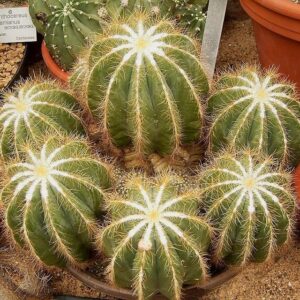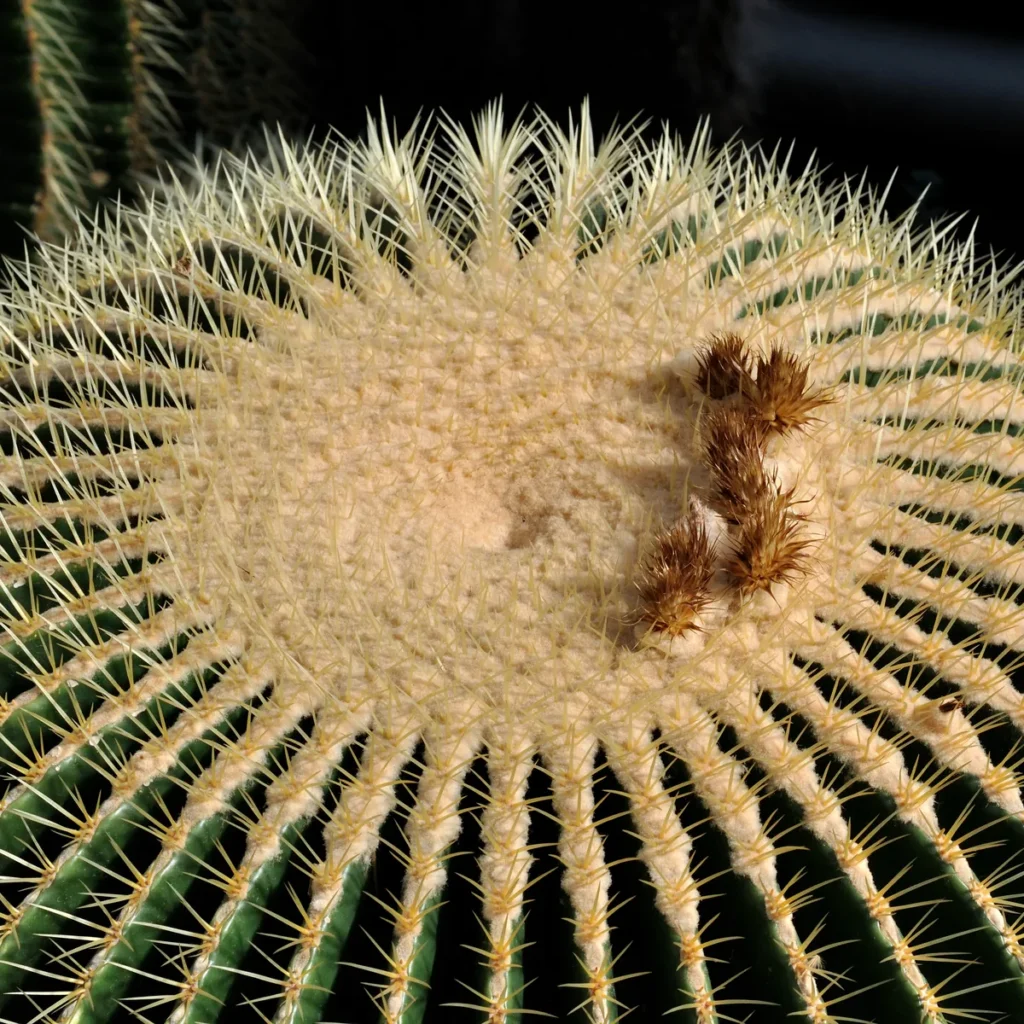
Golden barrel cactus stands out for its rounded shape and evenly arranged spines. A single plant can become a focal point in a planting scheme. Choose its position for growing conditions first and decorative effect second: an attractive but dark corner cannot replace suitable light. Also consider its distance from paths and whether you can care for the pot without brushing against the spines.
Plant profile
Scientific name: Kroenleinia grusonii.
Synonym: Echinocactus grusonii.
Family: Cactaceae.
Origin: Mexico.
Stem: rounded, with deep ribs.
Spines: yellowish.
Flowers: yellow, on mature plants.
Light: sun, with gradual acclimatisation.
Growing conditions
The Royal Horticultural Society recommends full sun and a very freely draining mix with additional mineral material. Water moderately during active growth; during genuine dormancy, its guidance is to withhold watering. It also recommends two or three applications of a balanced liquid fertiliser during growth. Excessive atmospheric humidity can mark the surface. The species needs no pruning and may develop mealybugs.
As general guidance for container-grown cacti, the University of Minnesota recommends drainage holes, emptying accumulated water and allowing the mix to dry between waterings. When moving a plant outdoors, increase sun exposure gradually. These general recommendations complement rather than replace the species’ needs.
Propagating golden barrel cactus
The RHS lists seed propagation for Kroenleinia grusonii. The method below is general cactus guidance, not a protocol specific to this species.
The University of Arizona recommends a shallow, wide container with drainage, filled with equal parts perlite and well-rotted organic compost without manure. Scatter fresh seed and cover very lightly with coarse sand. Moisten from below, allow to drain and cover with plastic. Keep in bright light out of direct sun. After germination, gradually open the cover and remove it after a few days. Maintain moisture without allowing the mix to dry completely or become waterlogged. The reference allows transplanting at roughly 1.3 cm in diameter, but does not guarantee how soon seedlings will reach that size.
Brazilian research also looks at propagation under laboratory conditions. A 2020 Embrapa Tropical Agroindustry study evaluated in vitro germination, seedling growth and micropropagation of this species, relating the work to plant production and conservation. This is distinct from the home seed-sowing method described above.
Marks and suspected rot
Not every mark on the surface means rot. The Connecticut Agricultural Experiment Station distinguishes superficial cork-like changes from wet lesions that enlarge and darken. This is general cactus guidance. If an area is softening or expanding, record its appearance and seek assessment before cutting tissue or applying products. Review drainage and watering history as well.
Repotting and handling the spines
General advice from the University of Florida suggests assessing the need to repot when roots emerge from the drainage holes. Choose a slightly larger pot. Thick gloves may not stop strong spines; barbecue tongs can help lift the plant gently. Loosen the roots and inspect them. Fill around the root ball with a freely draining mix, keeping the previous planting depth. Wait a few days before the first watering. If disease is suspected, seek assessment before cutting.
Common questions
Should I change the plant label? You can record both names: “Kroenleinia grusonii, synonym Echinocactus grusonii.” This connects the current name with the name often found in the nursery trade.
Should watering follow fixed months? Do not automatically transfer a British calendar to a different climate. Observe growth, temperature, light and drying. The distinction between active growth and dormancy is more useful than a universal list of months.
Will a small plant flower soon? Do not count on it: the RHS associates flowers with mature specimens. Appreciate the whole plant without making flowering a condition for success.
Sources
Embrapa Tropical Agroindustry: in vitro propagation of Echinocactus grusonii (2020).
Connecticut Agricultural Experiment Station: cactus problems.
University of Arizona: sowing cacti, page 3.
University of Florida: repotting cacti.
Photograph: Quartl / Wikimedia Commons, CC BY-SA 3.0. Square framing preserved, resized where necessary and compressed to a 1200 × 1200 px WebP without enlargement. Derivative shared under CC BY-SA 3.0.