White cotton-like patches or small plates attached to stems may be signs of mealybugs or scale insects. Before reaching for a spray, establish what is actually there. Identifying the problem, separating the plant and monitoring it is a more useful starting point than trying several products in succession.
This guide focuses on ornamental plants in pots and small gardens. Agricultural recommendations for orchards must not automatically be transferred indoors.
Recognizing the signs
Mealybugs often have a white, waxy covering. Other scale insects resemble small shells on leaves and stems. They feed on plants and can reduce vigor. Some produce sugary honeydew that attracts ants and supports dark sooty mold, but not all scales leave honeydew and not every white speck is an insect.
Use good lighting and a magnifying glass if possible. Check leaf undersides, leaf joints and new shoots. Take both a close-up photograph and a picture of the whole plant. Avoid scraping healthy tissue simply to test a suspicion.
Mealybugs, aphids or a harmless deposit?
Cotton-like material: look for the insect among the filaments without damaging the plant. Some mealybugs produce waxy egg masses, while some aphids also have woolly coverings. Color alone cannot distinguish them. A sharp photo with a nearby ruler for scale can help.
Immobile plates: these could be scale insects, but they might be normal plant structures or healed tissue. Do not scrape every brown mark from a stem. Lack of movement does not rule out an insect: many adults remain fixed while young stages move.
Sticky or blackened leaves: look for sap-feeding insects, including aphids. Removing sooty mold may improve visibility, but it does not remove the source of the honeydew. See the RHS guide to scale insects for identification clues.
Separate the pot and inspect nearby plants
Move the suspect plant away from others while investigating. Inspect neighboring pots, even if they look healthy, and clean hands and tools after handling the affected plant. Record the date, where insects were found and what action you took. This helps distinguish a new infestation from old, dry residue.
Keep the isolated plant in suitable light and growing conditions. Isolation does not mean putting it in darkness or unfamiliar strong sun. Prevent foliage touching nearby plants and do not take cuttings from the suspect specimen.
Inspect the pot rim and exterior, stakes and ties as well as leaves. The University of Connecticut identifies stakes and tape as possible hiding places. Cleaning only the visible tops of leaves can miss these areas.
Careful removal for small infestations
For a localized infestation, gently removing visible insects can help. Depending on the plant’s toughness, use a soft damp cloth or a gentle wash with water. Support delicate leaves and avoid jets that break shoots or scatter potting mix.
Work where you can collect debris without bringing the affected pot into contact with healthy plants. Do not rub fragile leaves hard enough to remove their protective surface. A heavily affected small branch may be pruned where appropriate, but avoid removing a large part of an already weakened plant.
One cleaning does not guarantee that every life stage has been removed. Inspect again, including hidden areas. If the infestation returns or is widespread, identify the group involved before selecting another method.
What if mealybugs are on the roots?
Some groups live on roots and may be missed during foliage cleaning. Poor vigor without visible insects calls for a review of watering, drainage and roots, not an immediate assumption of pests. If removing the root ball is justified, look for insects and wax attached to roots rather than loose white particles alone.
Perlite, mineral deposits and fungal growth can also look white. Confirm identification before disturbing the plant. Spraying leaves will not reach a root infestation, and pouring alcohol, detergent or a randomly chosen pesticide into the mix can make matters worse. The RHS mealybug guide also covers root-associated groups.
Why indiscriminate homemade mixtures are risky
Dishwashing detergent, alcohol and oils can damage some plants, especially at unsuitable concentrations. Combining ingredients or increasing strength makes the outcome less predictable. “Natural” does not mean safe or effective for every use.
If a plant-protection product is needed, seek technical advice and choose only a formulation authorized for the plant, pest and application setting in your country. Follow its label, including protective equipment, restrictions and intervals. Do not adapt agricultural doses for houseplants or combine treatments without guidance.
Check the actual setting, not just the word “plants” on a description. Outdoor authorization does not mean indoor use is allowed. Consider plant-species exclusions, children and pets, and instructions for returning to a treated area. Old marks are not a reason to spray more frequently.
Commercial products: examples from Brazil, not universal recommendations
The following examples come from the Brazilian article and manufacturers’ information. Their availability or mention here does not establish authorization elsewhere. Check the exact local formulation and current label. A product for ornamental gardening is not automatically suitable for vegetables, herbs or fruit trees. Concentrates and ready-to-use products have different preparation requirements.
FORTH Mata Cochonilha, ready-to-use 500 ml: the manufacturer describes 0.025% deltamethrin, acting by contact and/or ingestion. It needs no dilution. The official shop excludes succulents and ferns. Do not improvise an application to roots or potting mix.
Vitaplan Protege Pulgão e Cochonilha, 500 ml: the Nutriplan page confirms the pack and target pests, but the consulted text does not give the active ingredient or complete restrictions. Check the label instead of assuming it matches FORTH or suits every ornamental.
Óleo Vegetal Dimy: the manufacturer’s product information describes a product requiring dilution, not a ready-to-use spray. It warns against mixing with sulfur-based products and application in the hottest conditions. Leaf-cleaning claims do not make it suitable for every species.
Neem: choose an identified formulation rather than treating all neem oils as equivalent. The original article gives Dimyneem ready-to-use 500 ml as a Brazilian example. Do not transfer doses between ready-to-use and concentrated versions, or assume neem and other vegetable oils have the same composition or action.
Jardim Primavera Mata Cochonilha: the product appears in the manufacturer’s catalog, but the original review could not confirm its complete formulation or restrictions. Request the current label; do not infer an active ingredient or suitability for maidenhair ferns.
For any product, follow the label for protection, dose, interval, location and re-entry. Keep it away from children and pets. Do not spray bees or other beneficial insects directly; observe flower and pollinator restrictions. Prevent drift toward aquariums, ponds and waterways. These descriptions do not replace the label or verify each product’s current registration.
How to tell whether control is working
Return to the photographed points and check shoots that grew after cleaning. New insects, fresh wax and spread to other branches are more useful signs of activity than an old leaf that remains yellow. Record what appeared after the intervention.
Continue checking over the following weeks and during watering. Fewer insects is progress, but one inspection without findings does not prove every hiding place is clear. If using a product, its application interval comes from the label, not from how often you inspect the pot.
If the infestation repeatedly returns, increases or reaches many pots, seek expert identification. For a severely affected plant, disposal may deserve consideration rather than endless spraying. Do not give away an infested plant or propagate it. The University of Maryland discusses indoor mealybug control and its limits.
Preventing spread through your collection
Inspect new plants before placing them beside established ones. Make checks part of watering, looking beyond the upper surface of one leaf. When asking a nursery or professional for help, provide photos, growing conditions, dates and details of anything already applied. This avoids repeating unsuccessful treatments.
Common questions
Are ants the cause? They may be associated with honeydew-producing insects. Their presence is a reason to inspect, not proof of a particular pest.
Will one application solve it? There is no guarantee. The insect group, severity, plant and follow-up all affect results.
Do yellow leaves confirm scale insects? No. Yellowing has other causes. Look for the insect before attributing the symptom to pests.
Further sources and photograph
Embrapa: scale-insect biology; University of Minnesota: insects on indoor plants; University of California IPM: houseplant problems. The agricultural Embrapa reference provides biological context, not an indoor application recipe.
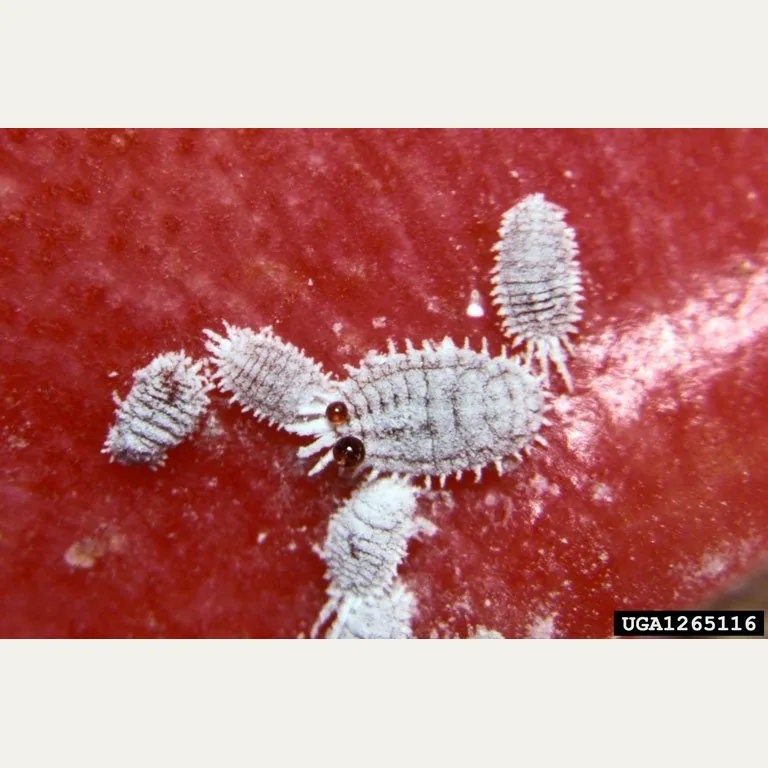
Featured photograph: mealybugs (Pseudococcus calceolariae), USDA ARS Photo Unit / Bugwood.org, via Wikimedia Commons, CC BY 3.0 US. Framed square with neutral margins and converted to WebP.