You touch a plant pot and tiny insects take flight. It is tempting to look for something to pour into the soil, but start with a different question: are they actually coming from the potting mix? That observation helps you avoid treating the wrong place or confusing different insects.
What could these tiny flies be?
In pots kept very damp, fungus gnats are one possibility. The adults are small flies; their larvae live in the growing medium. An insect is not a fungus gnat simply because it is dark and flies near a plant.
Notice whether the insects emerge when you disturb a pot or gather around fruit, drains or another part of the house. If you cannot identify the group, take a close-up photograph and seek advice. This guide concerns gnats associated with potting mix, not mosquitoes that transmit dengue.
Adults do not directly damage plants. Larvae generally feed on fungi and decaying organic matter, although large populations can harm roots. Eggs, larvae, pupae and adults may all be present at once, so catching the flying adults does not end the need to monitor the pots.
Adult, larva or another insect: what to look for
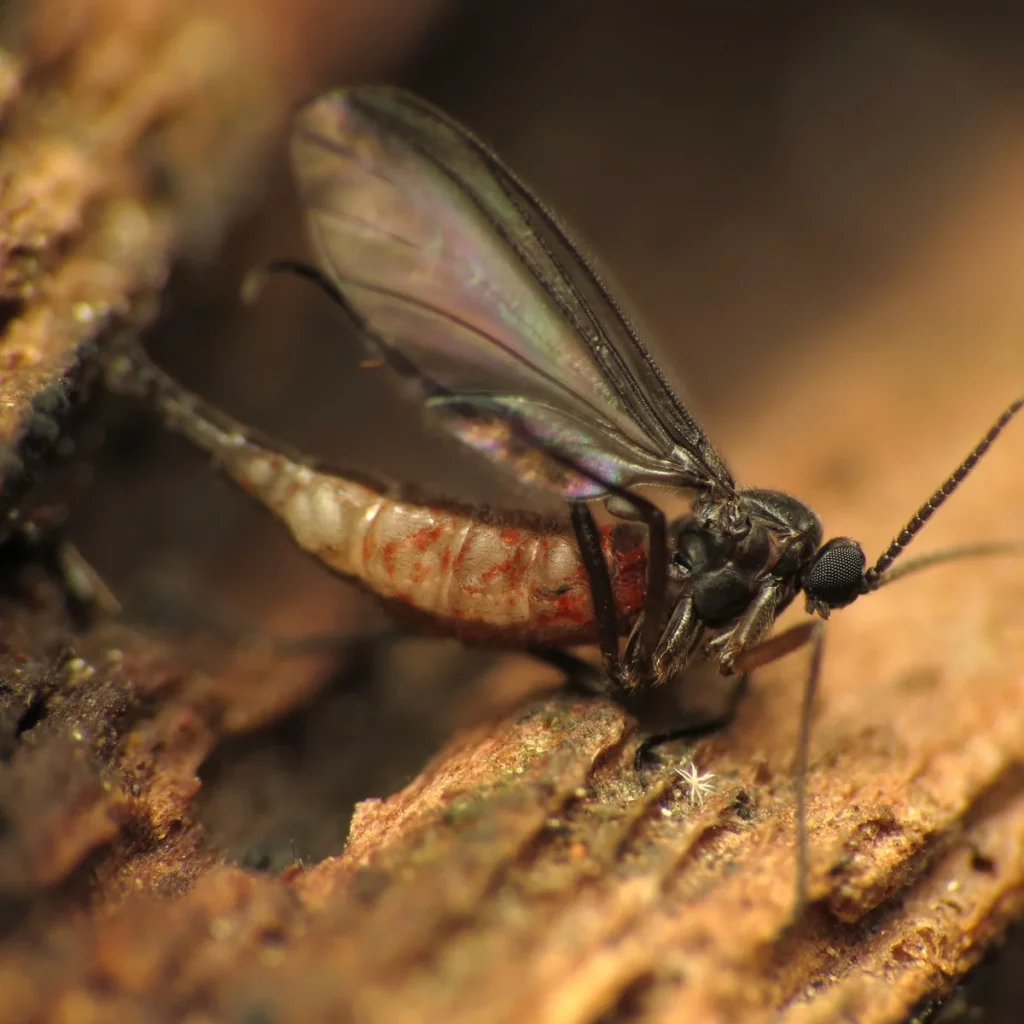
Adult fungus gnats have delicate bodies, long legs and antennae, and are generally only a few millimeters long. They often make short flights or walk across the potting mix. Larvae look like small, pale or translucent legless worms with dark heads. A magnifying glass or enlarged photograph can help; a tiny black dot alone does not confirm the identification.
Fungus gnats are not Aedes aegypti mosquitoes. Adult fungus gnats do not bite people, but that statement applies only after identification. Do not assume every mosquito near a pot is harmless. Larvae moving in standing water in a saucer call for mosquito-breeding prevention, not the potting-mix measures described here. Remove standing water and follow local environmental-health guidance if in doubt.
What to check before treating anything
Check how often you actually water, moisture below the surface, and any water trapped in a decorative outer pot. Look for fallen leaves or other debris on the mix. Identify which pots have insects rather than assuming every plant needs the same treatment.
Ask a simple question: does the pot dry between waterings as the plant requires, or does it stay constantly wet? This points you toward the growing conditions that need attention.
Look for a pattern rather than relying on a single sign. Label pots separately if several stand together. Insects gathering at a window may have emerged from a nearby pot, so their position at the window does not necessarily identify the breeding site.
Adjust moisture without drying out the plant
Continuously damp potting mix favors the problem. Reduce overwatering, allow the surface to dry when appropriate for the plant, check drainage and remove dead plant material from the surface.
This does not mean letting every root dry out completely. A plant that needs regular moisture should not be treated like a cactus. Do not replace excess water with severe drought.
For example, if a moisture-loving plant starts wilting during an attempted drying period, stop and reassess. If a pot remains heavy and wet, work out why the water is staying there. Watering by the calendar without checking the actual conditions makes these situations harder to distinguish.
Consider recent changes too. Has the plant moved into a darker corner? Has the temperature fallen? Has an old potting mix changed structure? Water use and drying can change even when your watering schedule stays exactly the same. There is no single interval for every pot.
Yellow sticky traps: what they can and cannot do
Yellow sticky traps help monitor and catch adults. They do not, on their own, remove larvae living in the growing medium. Use catch numbers alongside pot conditions to follow changes over time.
Place traps according to their instructions, away from leaves and out of reach of children and pets. Compare similar monitoring periods: a trap exposed for a month cannot be compared directly with one used for a day.
Replace or reposition traps as the manufacturer directs. A trapped fly is not proof that it came from that particular pot, since the adhesive may catch other insects. Vinegar traps used for fruit flies are not equivalent tools for monitoring fungus gnats.
Avoid cycling through homemade mixtures
Do not pour detergent, bleach or mixed household products into the pot. These attempts can damage the plant without even establishing which insect is involved. Start by finding the source and correcting favorable conditions.
If insects remain numerous or plants lose vigor, seek qualified advice. Consider biological or chemical products only when they are authorized for the specific use where you live and have suitable label instructions. Do not transfer recipes or doses from products sold in another country.
When should you investigate the roots?
Seedlings and young plants deserve extra attention when insects are numerous and growth declines. Even then, yellow leaves or wilting do not prove larval damage: watering and root problems commonly cause those symptoms too. If a plant wilts while the mix is wet, automatically adding water can make things worse. Our guide to yellow leaves and their possible causes explains how to assess the wider picture.
Do not unpot your entire collection after finding one adult. Identify symptomatic pots and review what has changed. If a container stays waterlogged, smells unpleasant or holds a plant that keeps declining, ask for an assessment of the mix, drainage and roots. Bring photographs of the whole plant, the stem base and the insect, plus your watering history.
How to tell whether things are improving
Keep a short record for affected pots: which pot had insects; when you watered and when it started drying; when you placed or replaced traps; and what you changed. Take an initial photograph. At later checks, compare similar periods and assess adults, moisture and plant condition together. The aim is to reduce the infestation without harming the plant, not to promise elimination within hours.
An optional identification detail
A Y-shaped wing vein helps knowledgeable observers identify many fungus gnats. You do not need to see this detail before correcting excess moisture, but it shows why color and size alone can be misleading.
Sources
University of Maryland: locating the source and managing moisture
University of Wisconsin: life cycle and sticky traps
University of Minnesota: managing moisture without wilting plants
UC IPM: identification and root damage
Colorado State University: insect habits and growing conditions
City of Santos, Brazil: preventing Aedes breeding in pots and saucers (Portuguese)
Adapt growing advice to the plant species. A product mentioned in an overseas reference is not automatically approved for use locally; this guide therefore gives no brands, doses or application recipes.
Adult fungus gnat in the family Sciaridae. Photo: Katja Schulz / Wikimedia Commons, CC BY 2.0. Original framing preserved; resized to 1200 × 1200 pixels and compressed as WebP, without upscaling.
