A private well can be considered as a source of water for a garden or property, but drilling is not a shortcut to a guaranteed supply of pure water. The sensible starting point is to establish what water is needed, whether the site can provide it, what permissions apply and how quality will be monitored.
Jurisdiction note: this guide concerns Brazil. Federal health requirements and state groundwater-authorisation procedures do not automatically apply in another country or establish the same permit process in every Brazilian state. Consult the competent local water and health authorities.
This planning guide concerns projects in Brazil. It is not a drilling manual or a substitute for a site assessment by a qualified professional. Readers elsewhere should consult the authorities and technical requirements where their property is located.
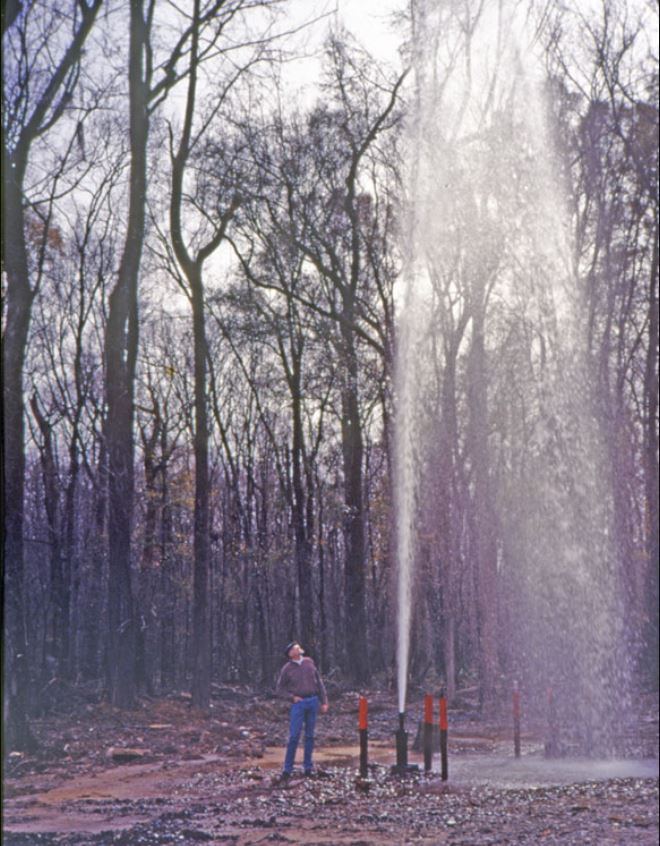
What makes a well artesian?
The term describes pressure, not simply depth. The US Geological Survey explains that water in a confined aquifer can rise in a well above the top of that aquifer. Only when it reaches above ground level does a flowing artesian well discharge naturally at the surface. A deep drilled well is not automatically artesian, and an artesian well need not flow at ground level.

Start with demand and the site
List the intended uses separately: garden irrigation, cleaning, food preparation and drinking are not interchangeable demands. Estimate the area to irrigate and discuss seasonal needs with the project professional. A proposed well should be assessed against those needs, rather than choosing a pump first and hoping the supply will match it.
Ask for a hydrogeological assessment, including available information about nearby wells and the local aquifer. Regional maps are useful background, not a guarantee of the yield or quality at one property. Request a clear explanation of uncertainty, the planned tests and what happens if drilling does not produce the expected result.
The location needs particular care around septic systems and other potential contamination sources. Do not treat a distance quoted in a general article as a guarantee of protection. The responsible professional should establish the appropriate location and protective construction for the site’s conditions and applicable requirements.
Check Brazilian permissions before drilling
According to Brazil’s National Water and Sanitation Agency, ANA, groundwater management and authorization, including well drilling, are state responsibilities. Contact the competent state authority before work starts to establish the required authorization, registration and water-use procedures for the particular project. This allocation of responsibility concerns Brazil; another country or Brazilian state may have different procedures, which must be checked locally.
Do not assume that a contractor’s quotation is itself permission to drill or use groundwater. Ask which documents are required, who will obtain them and what operating conditions must be followed. This guide does not establish a single permit procedure for every Brazilian state.
Budget for an operating system, not just a hole
A useful quotation separates assessment, drilling, casing and protective construction, testing, pump and electrical installation, and any necessary storage or treatment. It should also explain maintenance, future sampling and the costs of an unsuccessful drilling attempt. These questions make competing proposals easier to compare.
Construction and equipment selection belong to qualified professionals. Ask for the completed well’s records and operating instructions, not just a demonstration that water comes out. Retain the authorization documents, laboratory reports and maintenance history together.
Water quality must be demonstrated
Brazil’s Ministry of Health requires water for drinking, food preparation and personal hygiene to meet potability standards. Being underground, looking clear or tasting acceptable is not a substitute for testing. Ask the laboratory and responsible health authority what sampling and analyses are appropriate for the intended use and local risks. This reference is to Brazil’s federal health framework; outside Brazil, consult the local health authority about applicable drinking-water standards.
The CDC’s well-water testing guidance also stresses the owner’s responsibility to test and to use another safe water source when harmful contamination is found, with professional advice on the next steps. That health principle is useful here; US regulatory arrangements should not be confused with Brazilian law.
A satisfactory result is not a permanent certificate for the well. Agree on continued monitoring and the circumstances requiring a new assessment. Treatment, where necessary, must address the identified problem rather than relying on the idea that any household filter makes any water safe.
Irrigation needs its own assessment
Water suitable for one crop and soil may cause difficulties elsewhere. Embrapa’s guide to irrigation-water quality considers salinity, sodicity and toxicity, among other factors. In everyday terms, the amount and balance of dissolved salts matter, as does the sensitivity of the plants and the way the soil drains.
Do not assume groundwater is better for plants simply because it is untreated. Have the results interpreted for the garden and irrigation equipment concerned. The best project is one whose water availability, quality, legal conditions and running costs have all been evaluated before the garden depends on it.
For a garden dominated by grass, the lawn planning and watering guide helps separate lawn-care decisions from the technical design of the well. The water source still needs its own quality and permit assessment.
Cover: a flowing artesian well, photographed by Mark C. Mastin / USGS, public domain. The photograph illustrates artesian flow; it does not establish water potability or the depth of the well.