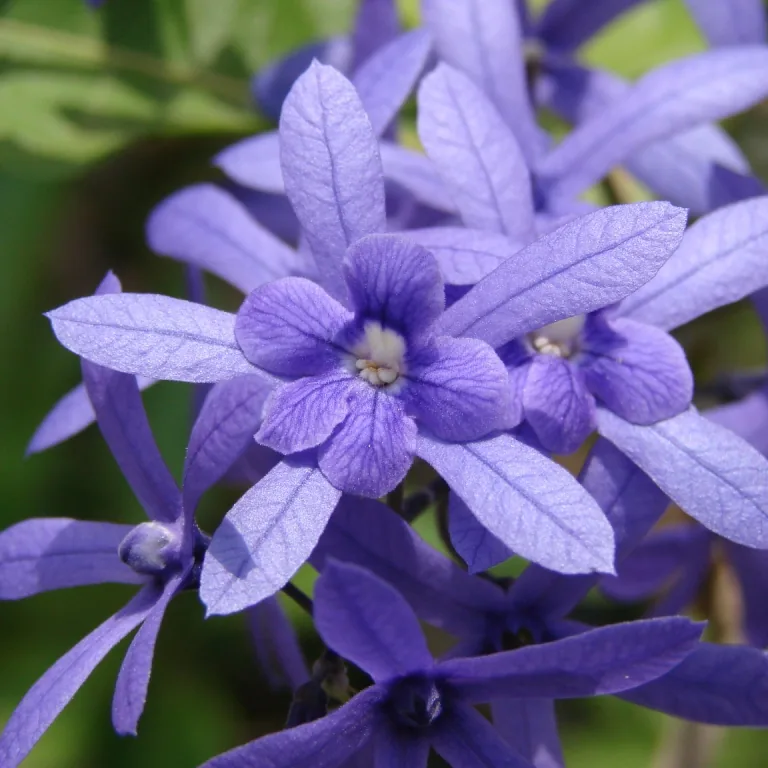
Queen’s wreath (Petrea volubilis), also called sandpaper vine, carries hanging clusters of violet-blue stars. Some of that colour remains after the petals fall: the lasting stars are the calyces, the outer parts of the flowers. This is a woody climber to plan around, not a small flowering plant to squeeze into a spare corner.
A quick plant profile
Family: Verbenaceae. Origin: tropical America. Life cycle: perennial. Habit: woody climber, sometimes trained as a shrub. Light: sun to partial shade. The roughly 6 m (20 ft) height recorded by NParks is a useful planning reference, not an absolute limit in every garden.
Choose the position and support first
Give the plant a sunny place if flowers are the priority. Some shade is tolerated, but heavy shade can reduce the display. It is a tropical species: protect young plants from frost, and do not assume it will remain leafy through a cold winter. Leaf loss varies with the weather, so it may not provide an uninterrupted privacy screen.
A securely fixed trellis, pergola or fence should be ready before the stems become heavy. Leave room to inspect the supports and reach the plant for maintenance. UF/IFAS also describes growing it in a large container. Choose the position for its eventual spread rather than the size of the nursery pot.
Planting and training the stems
For an established nursery plant, prepare a well-drained site and make a hole wider than the root ball, without burying the woody base. Keep the point where the upper roots meet the stem above the surrounding soil surface. Backfill around the sides, water to settle the soil and keep mulch away from the stem. These steps apply the UF/IFAS shrub-planting guidance; avoid making a rich pocket at the bottom of a hole that collects water.
Spread young, flexible stems over their support and secure them with soft ties, leaving room for thickening. Check the ties as growth continues. Do not force stiff branches into sharp bends or trap woody stems between the trellis and a wall. A temporary cane can bridge the gap until new growth reaches the permanent support. The RHS guide to tying in climbers explains this approach.
Watering without a rigid calendar
Newly planted roots need closer attention than an established vine. Check the root ball as well as nearby soil: rainfall does not always wet both evenly. Once the plant has settled in, irrigation needs usually decrease. Adjust to heat, rain and drying rather than automatically watering on fixed days.
In a container, use a fertile, well-drained growing medium and make sure water can escape. A large pot should not mean a permanently saturated root zone. Before adding fertiliser to a struggling plant, check light, drainage and moisture together.
Flowers, pruning and signs worth checking
As the flower cluster ages, the coloured calyces eventually dry and turn brown. That change alone is not a disease. Nor should every young plant be expected to bloom immediately: UF/IFAS gives two or three years as a reference for flowering after planting, not a promise for every climate or nursery plant.
Remove dead growth, guide new stems into gaps and shorten shoots that overrun their allotted space. Avoid repeatedly cutting shoots carrying buds. The RHS pruning guide stresses that timing matters for flowering climbers. Observe your plant’s flowering cycle rather than copying a calendar written for another hemisphere.
Scale insects, mealybugs and spider mites can occur, particularly under sheltered conditions. Inspect stems and leaf undersides if growth weakens. Cold-related leaf fall is different from progressive spotting, dying branches or visible pests. A list of possible pests is not a reason to spray preventively.
How to propagate queen’s wreath
Seed and stem cuttings are recorded methods; air layering is another option described by UF/IFAS. A rooted nursery plant is the simpler starting point if your main goal is to establish a flowering climber rather than experiment with propagation.
For semi-ripe cuttings, select healthy stems whose bases have begun to firm. The Universidad Juárez Autónoma de Tabasco describes this type of material for the species. It means a piece of stem, not a detached leaf. The following care follows general RHS guidance, not a guaranteed rooting schedule for petrea.
Remove the lower leaves, insert the cutting into moist, free-draining propagation compost and keep it in bright light out of direct sun. A clear cover can reduce moisture loss; ventilate regularly and prevent waterlogging. Once rooted, gradually reduce the shelter before moving the young plant on. A new shoot on its own is not proof that a strong root system has formed.
Common questions
Are rough leaves a sign of thirst? No. Their sandpaper-like texture is a characteristic of the species. Judge watering from moisture and the plant’s overall condition.
Is there a white-flowered form? Yes, ‘Albiflora’. Confirm the cultivar when buying if colour is important to the design.
Will a seedling flower in its first year? Not normally, according to NC State Extension. Check maturity, light and general vigour before trying to force flowers with more fertiliser.
Photo: João Medeiros, CC BY 2.0. Square crop and WebP compression, without enlargement.