A recovering forest should also be assessed by the variety of plants it supports. In an English-language report published on November 11, 2026, Agência FAPESP presented research discussed at FAPESP Week Netherlands, held October 27–29, highlighting the limits of measuring restoration solely through accumulated carbon.
What the plantings revealed
According to the report, Crislaine de Almeida’s doctoral research examined records from more than a thousand Atlantic Forest restoration plantings, using data from the SOS Mata Atlântica Foundation. It identified 423 tree species used across those plantings. Repeating similar sets of species in different regions can make plant communities increasingly alike, a process known as biotic homogenization.
Ricardo Augusto Gorne Viani, a researcher at the Federal University of São Carlos (UFSCar), explains that the surrounding landscape matters. Near well-preserved forests, seeds arriving naturally may increase diversity after planting. In degraded, isolated areas, deliberately introducing a wider variety of native species becomes more important.
What the data compare, and what they do not show
The coverage is recent, but the research has an earlier history. Almeida’s thesis, defended at Esalq-USP in 2022, compared 1,073 planting lists from the Click Árvore program, carried out between 2002 and 2018, with surveys of 268 forest remnants in the TreeCo database. These are not 1,073 forests whose monitoring began in 2026.
The 423 species refer to the full set of plantings analyzed, not the number found at each site. The comparison showed that the plantings were more similar to one another than to remnants of the same forest type. This finding supports a discussion about species selection, but it does not measure every aspect of ecological recovery at each site or show that every carbon project has the same problem.
A longer species list is not enough
The aim is not simply to assemble the longest possible list. A combination of species needs to represent the reference vegetation and suit the site’s conditions. Mixing plants from different environments merely to increase the count can move a project away from the ecosystem it aims to restore.
Consider two plantings with the same total number of seedlings. One repeats a few species; the other includes locally appropriate plants with different growth and reproductive strategies. Counting individual plants does not reveal that difference. Nor does the initial list alone tell us which plants survived, whether natural regeneration occurred, or how the community changed over time.
A question beyond the number of trees
Projeto Jardinando’s perspective: when looking at a restoration project, ask which plants are returning, where they come from, and how they will be monitored. Seedling numbers and tree growth help tell the story, but they do not tell all of it.
The findings are a warning for planning, not a universal recipe for species selection. Choices need to reflect the ecosystem and local conditions. Recovering carbon stocks and recovering diversity are related goals, but achieving one does not automatically demonstrate the other.
When reading about a project, look for four pieces of information: which ecosystem provides the reference; why those species were chosen; how survival and regeneration will be monitored; and when results will be reassessed. These are questions for following progress, not a universal species list or a verdict on a particular project.
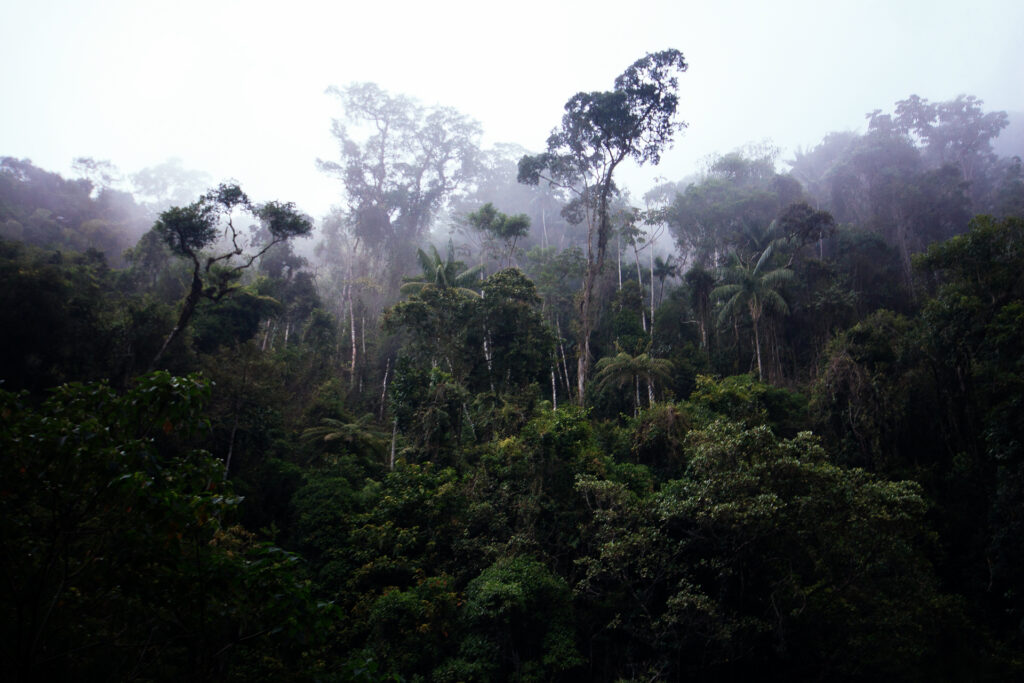
Cover photo: Atlantic Forest in Itatiaia National Park, Rio de Janeiro, photographed June 24, 2016. Illustrative image, not a documentary photograph of the plantings studied. Photo: João P. Burini / Wikimedia Commons, CC BY-SA 4.0, unaltered. Source consulted for the original article on November 11, 2026.
Usamos cookies em nosso site para fornecer a melhor experiência de uso, lembrando suas preferências e visitas repetidas. Ao clicar em “Aceitar”, concorda com a utilização de TODOS os cookies.
Este site usa cookies para melhorar sua experiência enquanto você navega pelo site. Destes cookies, os cookies que são categorizados como necessários são armazenados no seu navegador, pois são essenciais para o

funcionamento das funcionalidades básicas do site. Também usamos cookies de terceiros que nos ajudam a analisar e entender como você usa este site. Esses cookies serão armazenados em seu navegador apenas com

o seu consentimento. Você também tem a opção de bloquear esses cookies. Porém, a desativação de alguns desses cookies pode afetar sua experiência de navegação.
Os cookies necessários são absolutamente essenciais para o funcionamento adequado do site. Esta categoria inclui apenas cookies que garantem funcionalidades básicas e recursos de segurança do site. Esses cookies não armazenam nenhuma informação pessoal.
Quaisquer cookies que possam não ser particularmente necessários para o funcionamento do site e sejam usados especificamente para coletar dados pessoais do usuário por meio de análises, anúncios e outros conteúdos incorporados são denominados cookies não necessários. É obrigatório obter o consentimento do usuário antes de executar esses cookies no seu site.