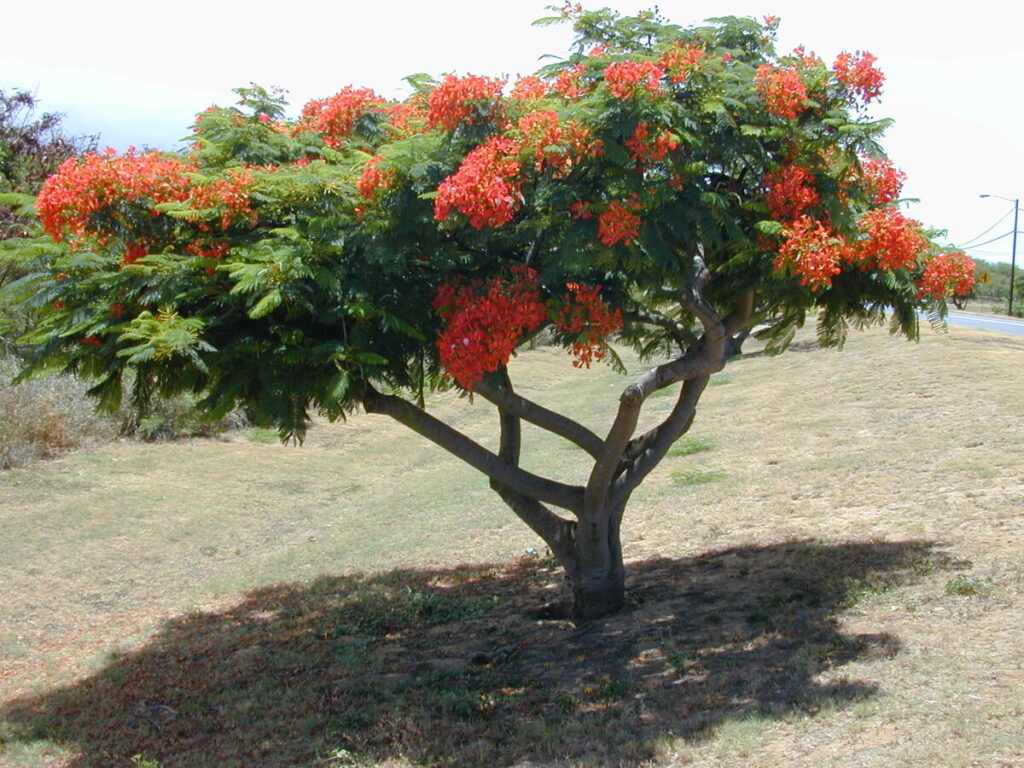
A royal poinciana in bloom can transform a garden, but its flowers should not be the only reason to plant one. Delonix regia, also called flamboyant or flame tree, needs room for a broad crown and spreading roots. Choosing the site matters more than choosing a fertilizer.
Get to know the tree
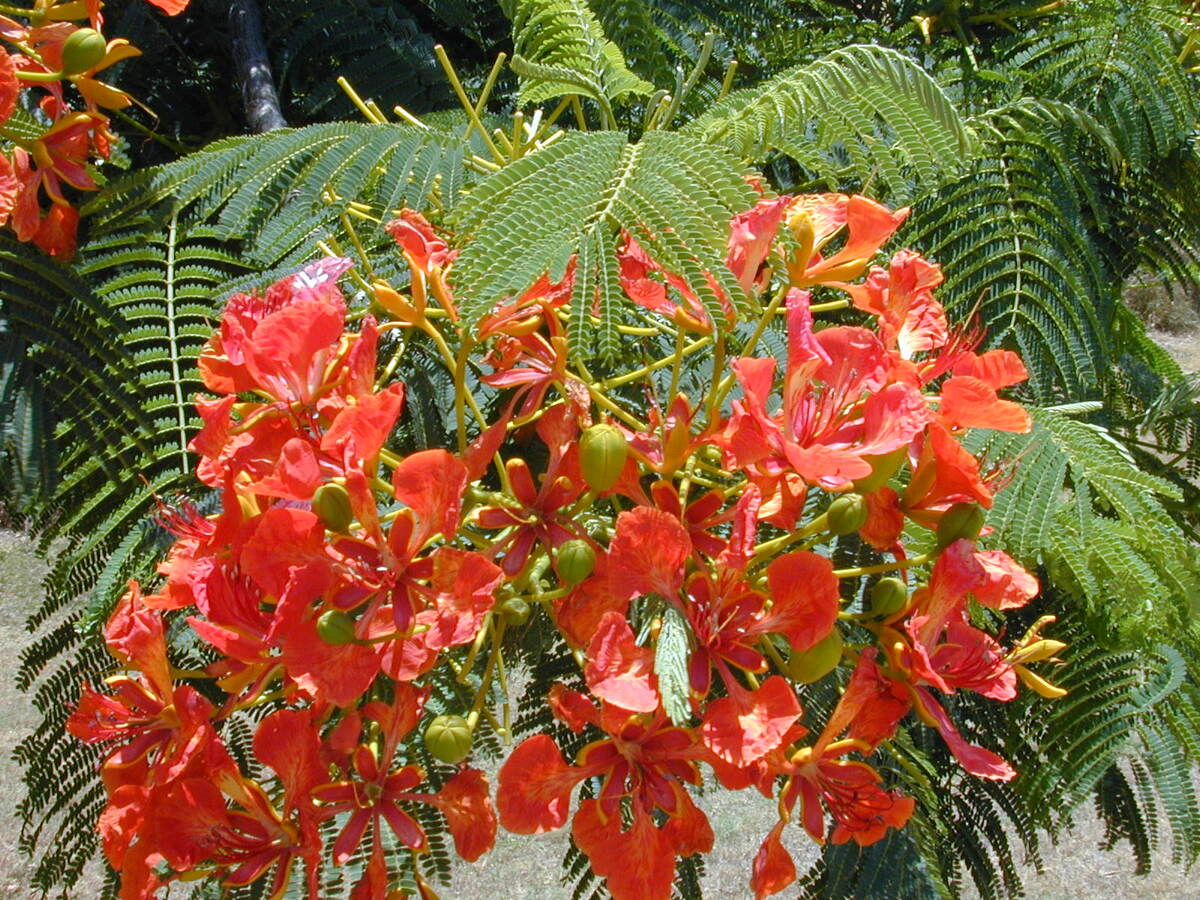
This Madagascar native belongs to the pea family, Fabaceae. Its finely divided leaves contrast with large red or orange flowers. The long, woody pods that follow are its fruits: a pod is a type of fruit, even when it is not grown for eating. Leaf shedding varies with climate, especially the dry season.
NParks records a crown spread of roughly 12–18 metres and heights of 9–20 metres. These figures describe potential size, not a promise that every tree will stay within a particular limit. A small nursery plant can eventually dominate the space around it.
Where should you plant it?
Choose an open, sunny site with well-drained soil. Kew warns that roots can damage paving, drains and foundations, while brittle branches can fall. A narrow pavement, the space beside a wall or a cramped yard is therefore a poor starting point.
Before planting, map buildings, underground services, overhead wires and paths. Ask a qualified local arborist to assess setbacks and mature canopy clearance rather than treating one distance as a universal guarantee. For street planting, consult the local authority first.
Water, sunlight and routine care
UF/IFAS recommends full sun for growth and flowering. Water young trees regularly while they establish; established trees tolerate drought, but may still need water during severe dry spells. That is different from saying an adult tree never needs watering. Keep drainage in mind instead of compensating for poor soil conditions with more irrigation.
Structural pruning while the tree is young helps develop better-attached branches. Large limbs and work near power lines belong with qualified professionals. Plan for fallen pods and leaves, too: this is not a maintenance-free tree.
Cold weather and flowering
Royal poinciana suits frost-free conditions. UF/IFAS notes that first flowering can take several years, sometimes much longer than five. A young tree without flowers is not automatically short of nutrients. Check its age, sunlight and climate before increasing fertilizer.
Seed propagation is possible. For a home garden, an identified nursery tree makes it easier to plan than collecting an unknown ornamental. Yellow-flowered forms of D. regia also exist; a different flower colour does not necessarily mean a different species.
Check its suitability for your region
UF/IFAS currently recommends caution in South Florida and management to prevent escape into natural areas. That regional assessment is not a worldwide prohibition. Check local guidance, particularly near native vegetation, before deciding whether this non-native tree is appropriate.
References and photo credits
NParks: identification, size and seasonal growth; Kew: origin and site selection; UF/IFAS: cultivation and structure; UF/IFAS Gardening Solutions: climate and flowering; UF/IFAS: regional assessment.
Cover: Forest & Kim Starr, Delonix regia in Kahului, Maui, CC BY 3.0. Resized and compressed.