What grows between harvests also matters to the crop that follows. Research involving the University of São Paulo’s CCARBON center linked crop diversification to more stable yields under rainfall extremes in Rio Grande do Sul, Brazil. Agência FAPESP reported the findings on November 3, 2026.
What was observed on the farms
According to the report, 13 experiments on commercial farms were followed over three growing seasons, between 2022 and 2025. Cover crops are grown to protect and improve soil rather than to provide the main commercial harvest.
The diversified systems produced yields as much as 76% above the state average. That figure compares output with the state average; it does not mean the technique universally causes a 76% increase. The analysis also linked diversification with greater soil water-storage capacity.
There are important limits. During the 2024 flood, 44% of farmers using diversification had to change their plans. Better management does not make a farm immune to disasters.
Context and significance
For anyone interested in growing plants, the story draws attention to something often left out of harvest photographs: how soil is cared for throughout the farming calendar. Evaluating a practice also means looking at production stability, not just the best result from one year.
The study concerns commercial farming. Its percentages cannot be transferred directly to pots, gardens or home vegetable plots. Its importance lies in broadening the discussion of agricultural adaptation to climate, with concrete results and explicit limits, without turning a promising strategy into a recipe for every piece of land.
Source: report by Elton Alisson, Agência FAPESP, published November 3, 2026. Study cited: Crop diversification shapes soil multifunctionality under common hydroclimatic extremes, in Agriculture, Ecosystems & Environment. This article provides an original summary of the results described by Agência FAPESP.
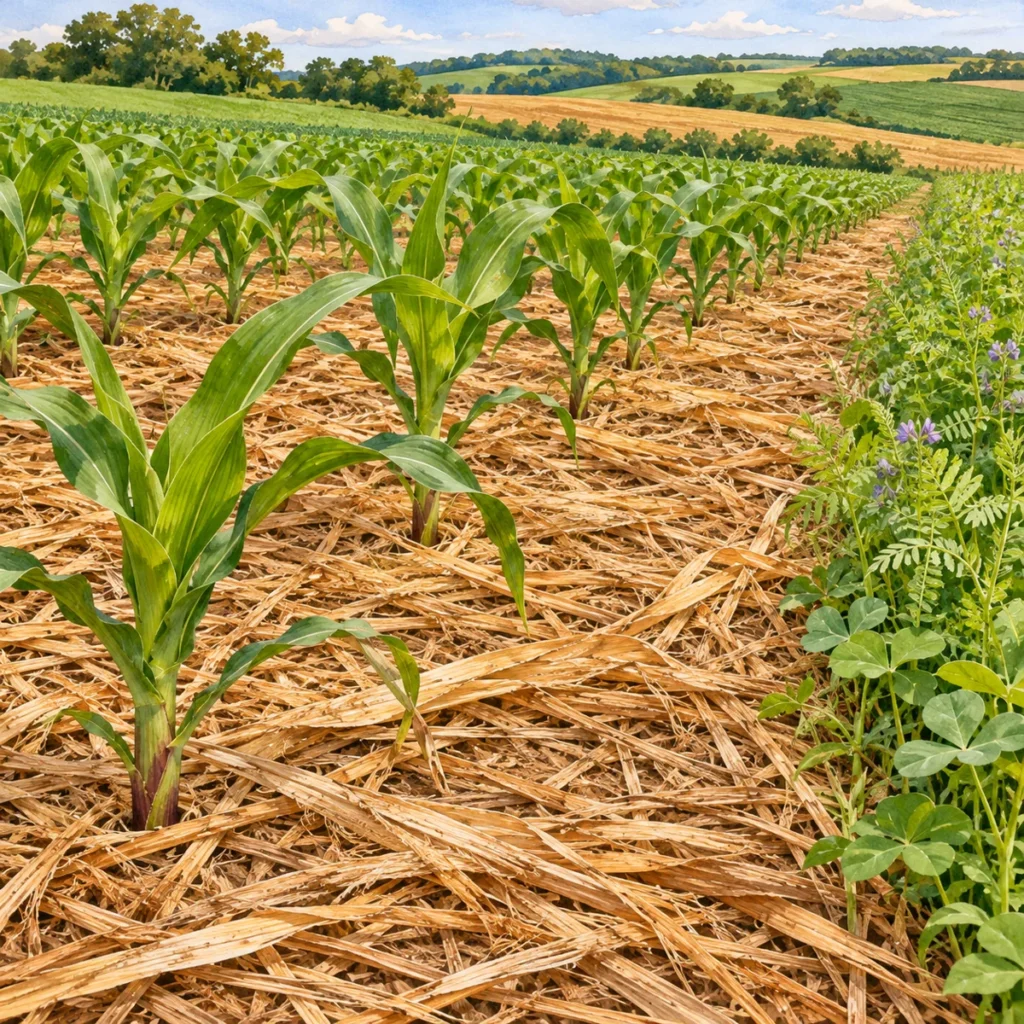
Illustration generated with artificial intelligence. The image is a conceptual representation of covered soil and does not show the experiments discussed.