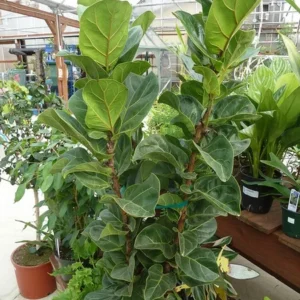
The traveller’s tree, Ravenala madagascariensis, is instantly recognizable by its enormous, fan-shaped crown. Long leaf stalks hold banana-like blades in a single plane, creating a striking outline in a tropical garden. Before planting one, however, look beyond the shape: this is a large plant that needs room and a warm climate.
Despite the familiar name traveller’s palm, it is not a true palm. It belongs to the Strelitziaceae family, alongside bird-of-paradise plants such as Strelitzia nicolai.
At a glance
Scientific name: Ravenala madagascariensis Sonn. Origin: Madagascar. Habit: a large, perennial, tree-like herbaceous plant that can form a clump. Size: roughly 7–15 m is a useful general indication, but mature dimensions vary with conditions and specimens may exceed this. It is not a small ornamental for a narrow corner.
Growing conditions: a warm, frost-free location, plenty of light and fertile soil that holds moisture without remaining waterlogged. Young plants need particular attention to watering while they become established. Mature plants can cope better with short dry periods, but that does not make them desert plants.
What gives the plant its fan shape?
Its large leaves are arranged in two opposing rows. Their long stalks extend outward and upward, making the familiar fan. Individual blades can be several metres long, so the apparent size of a young nursery plant is a poor guide to the space it will eventually occupy.
As it matures, a trunk-like stem becomes visible below the crown. Pale flowers develop in boat-shaped bracts among the leaf stalks. Woody capsules contain seeds with a striking blue covering, called an aril. Lemurs are among the pollinators reported in its native habitat.
Choose the position before planting
Use a traveller’s tree as a focal point in a spacious garden, rather than squeezing it beside a doorway or beneath overhead obstructions. Allow for both the height and the broad spread of the leaves. Groups can look impressive, but each plant still needs adequate space as it matures.
A sunny site generally supports strong growth. Protect plants raised in sheltered conditions from an abrupt move into harsh sun. Strong, persistent wind can tear the large leaves; a sheltered position helps preserve their appearance. Natural splitting does not automatically mean a plant has a disease.
Frost is a serious limitation. In colder regions, outdoor planting may be unsuitable and a heated conservatory or greenhouse may be needed. Container cultivation does not remove the need to consider eventual size and winter protection.
Water, soil and feeding
Check soil moisture rather than following a fixed weekly schedule. Water young plants regularly enough to prevent the root zone from drying out excessively, but avoid standing water around the roots. Rainfall, heat, wind and soil texture all change how quickly the ground dries.
Use fertile soil with organic matter and good drainage. If water remains pooled after rain, investigate drainage and site conditions before planting. Simply adding a little sand to compacted soil is not a reliable solution. When growth slows in cool conditions, reassess watering rather than continuing a summer routine automatically.
Feed during active growth according to the chosen product’s directions and the plant’s condition. A balanced fertilizer or suitable mature compost can be part of routine care; more fertilizer will not compensate for a waterlogged root zone or an unsuitable location.
Maintenance without unnecessary cutting
Remove old, dry or badly damaged leaves carefully when necessary. Avoid cutting healthy foliage simply to make a cramped planting fit its space. For a single-stemmed appearance, basal shoots can be managed as they develop; allowing them to remain produces a clump.
Large specimens require safe access and appropriate tools. If a leaf cannot be reached safely from the ground, use professional help rather than pulling it down or working from an unstable support.
Propagation: seeds or rooted shoots
The plant can be raised from seed, but germination may be slow and uneven. Use suitable propagation conditions rather than assuming every seed will sprout on the same timetable. The RHS gives 18–21°C for spring seed sowing under protected cultivation.
Dividing rooted basal shoots is another option. Select a shoot with its own roots, separate it carefully and replant it in a suitable growing medium. Protect the new plant while it establishes and keep the root zone moist without saturating it. A shoot without roots is not equivalent to an established division.
The traveller’s name: interesting, but not survival advice
The name is associated with stories of travellers collecting water held in the leaf bases. Treat this as botanical folklore, not a recommendation to drink it: collected water can contain debris and contamination. Do not rely on the plant as a source of drinking water.
Another story describes the leaf fan as a natural compass. Its orientation is not dependable enough for navigation. Choose your planting position for light, space and the view you want, not for a promised compass alignment.
The plant remains a powerful symbol of Madagascar’s remarkable flora. Its appeal in garden design comes from the contrast between a very simple outline and enormous leaves. Giving it enough room is the most important step toward keeping that effect as it grows.
References
NParks: Ravenala madagascariensis; University of Florida IFAS Extension: Travelers-Tree; Royal Horticultural Society: traveller’s palm; University of São Paulo: Ravenala; Royal Botanic Gardens, Kew: traveller’s palm.