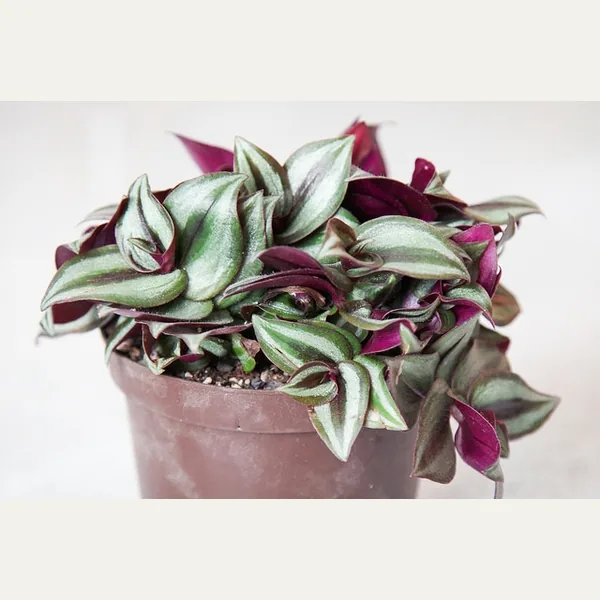
Inch plant stands out for the contrast between silver stripes, green areas and purple leaf undersides. Its stems spread and then trail over container edges, creating colour even without flowers. Tradescantia zebrina is vigorous foliage suited to pots and planters where you can monitor and control its spread.
Plant profile
Scientific name: Tradescantia zebrina.
Common names: inch plant, silver inch plant and zebra plant.
Family: Commelinaceae.
Origin: tropical America, from Mexico to Colombia.
Life cycle: perennial.
Habit: creeping or trailing, with succulent stems.
Size: low-growing, with stems that extend sideways.
Light: filtered light or bright partial shade.
Growing medium: fertile, moist and well drained.
Propagation: stem cuttings.
Handling: sap may cause contact irritation; wear gloves.
Choosing a position
Light affects the appearance of the leaves. In poorly lit spaces, stems may become sparse and lose some of their characteristic colour. Choose a bright spot, but do not suddenly move an indoor plant into strong sun. Intense exposure, especially in hot weather, can also damage foliage.
In hanging pots, keep stems away from walkways and pets. Sap contact deserves attention even when the plant is purely decorative. Choose a container you can remove from its support for easy watering and inspection.
Watering and potting mix
Use a mix that retains some moisture while letting excess water drain quickly. Water regularly during growth and let the mix lose some moisture between waterings. Reduce watering during slow growth. Water permanently accumulating around the roots encourages rot.
Check each pot separately, especially when several plants share a shelf. A wide planter and a small pot can need different care. Before watering, feel the mix and check that the container drains normally.
Pruning and renewal
For cuttings, choose healthy tips with nodes, the points where leaves emerge from the stem. Remove only the leaves from the section that will sit in water or growing medium. Keep a node in contact with moist mix or submerged in water, leaving the leaves above it. Roots emerge at these nodes; rooting hormone is unnecessary. Trimming the tips also encourages a fuller plant.
Older plants often become less dense at the base. Renewing some stems helps restore the display. Dispose of trimmings responsibly: the species has invasive potential, and pieces capable of rooting must not be dumped in natural areas.
Common questions
Does it flower? Yes. Flowers are small, usually pinkish or purplish, with three petals. They occur less often indoors.
Why are the stems long and sparse? Low light and ageing are possibilities. Review the position and consider renewal pruning.
Can I handle it without protection? The RHS warns of skin allergy, and NParks records irritation in people and dogs. Wear gloves and avoid getting sap on skin or in eyes.
How can I reduce spotting and rot? Direct water onto the growing medium and avoid keeping foliage wet or stems crowded together. Waterlogged soil encourages root and stem rot. If marks or soft areas appear, check drainage and inspect the plant before applying products. These signs alone do not establish a specific disease.
Sources
North Carolina State University.
Singapore National Parks Board (NParks).
University of Wisconsin–Madison: propagating Tradescantia zebrina.
Photograph: Maja Dumat, CC BY 4.0. Neutral borders added to fit the whole plant into a 1:1 image without cropping or enlargement; compressed to WebP.