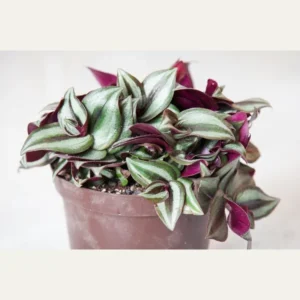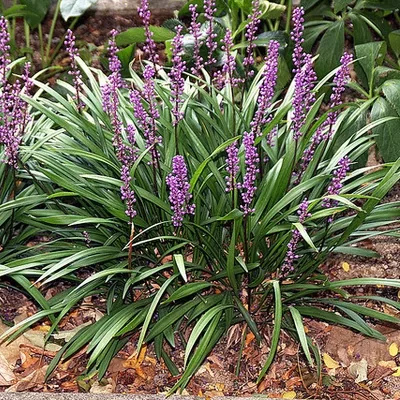
Lilyturf combines narrow, arching leaves with small flowers clustered on upright stems. Its shape helps define paths and fill the front of borders without relying entirely on flowers. Although it resembles grass, Liriope muscari belongs to the Asparagaceae family. It forms clumps, groups of shoots growing together at the base, and using it as groundcover does not mean treating it like a lawn.
Plant profile
Scientific name: Liriope muscari.
Common names: lilyturf and liriope.
Family: Asparagaceae.
Habit: an evergreen herbaceous perennial.
Size: approximately 25–45 cm tall, depending on growing conditions and the cultivar.
Leaves: long, narrow and arching. Variegated cultivars, selected garden varieties, have stripes of different colours.
Flowers: small and clustered on upright stems; colour varies among cultivars.
Uses: edging, groundcover, containers and planting beneath shrubs.
Propagation: division or seed. Division preserves a cultivar’s characteristics.
Light: where lilyturf grows and flowers best
Bright partial shade with some sun offers a good balance between foliage and flowers. It also grows in sunny positions provided the soil does not remain excessively dry. In deep shade it may produce leaves but few flower spikes. Assess light and moisture together before moving it.
Choose well-drained, acidic to neutral soil. In compacted clay or ground that holds water, address drainage before planting. A good-looking border depends more on this choice than on frequent feeding.
How to plant lilyturf
1. Water the root ball before removing the plant from its container.
2. Dig a hole as deep as the root ball and wider than it, leaving room for the roots.
3. Keep the top of the root ball level with the bed. Do not bury the bases of the leaves.
4. Backfill, firm gently and water to settle the soil.
The Royal Horticultural Society uses 30–45 cm between plants as a guide. Adjust this to the cultivar and the effect you want. Check new plants during dry spells; established clumps generally need less irrigation. Very dry soil can also explain weak growth, so check moisture before adding fertiliser.
Propagating by division
Prepare the replanting spots before lifting the plant. Choose a period outside vigorous active growth and avoid leaving roots exposed while organising the job. This follows the general method for dividing herbaceous perennials:
1. Loosen the soil around the clump and lift it carefully, preserving its roots.
2. Remove only enough excess soil to see where groups of shoots join.
3. Separate sections with shoots and roots of their own. Where they are firmly joined, use a sharp tool to divide the mass rather than breaking it into tiny pieces.
4. Replant promptly, settle the soil and water. Monitor moisture until the divisions resume growth.
Small pale swellings on the roots are normal lilyturf tubers, not automatically evidence of a pest.
Pruning and problems: what to look for
Division produces new plants; it does not need to become an annual chore to keep a healthy plant thriving. When tidying, avoid damaging the crown, where leaves emerge. If renewing the foliage, inspect the centre of the clump first. Do not cut new leaves already appearing or injure the crown. Tidy before local new growth begins rather than copying calendar months from another hemisphere.
Spots and drying leaves: brown marks can have different causes. Anthracnose is one recorded problem, encouraged by rain and frequently wet leaves. Avoid excessive overhead irrigation and remove diseased debris.
Yellowing that starts at the base: check drainage and look for rot in the crown or roots. Simply watering more may make matters worse. Do not propagate from suspect material; if the problem spreads, seek a technical diagnosis before applying products.
Lilyturf in containers
Check moisture below the surface, especially in hot or windy weather. If water does not drain, inspect the holes and the condition of the mix. When roots fill the container and growth slows, consider repotting or renewing the growing medium. Do not automatically apply the same watering routine used in a garden bed.
Common questions
Is lilyturf a grass? No. Use it for ornamental edging or groundcover rather than treating it as a lawn for everyday foot traffic.
Are Liriope muscari and Liriope spicata the same? No. The first forms clumps; the second spreads more freely across the ground. Check the scientific name, as the common name may refer to either.
Will seed preserve a variegated cultivar? Seedlings may differ from the original plant. Choose division to preserve the cultivar’s features.
Sources
North Carolina State University: identification.
RHS: light, soil and differences between species.
RHS: planting and propagation.
RHS: general division technique.
Clemson University: maintenance and problems.
Photograph: Manuel, via North Carolina State University, CC BY 2.0. Cropped to 1:1 and converted to WebP without enlargement.